An Ethnographic Study of Conservative Americans’ Relationships to Democracy

 With support from


.jpeg)
 copy.jpeg)
This study examines how conservative Americans in three counties — Campbell County, Wyoming; Ottawa County, Michigan; and Greenville County, South Carolina – experience and evaluate democracy.
The Central Argument
The conservatives we met believe democratic institutions have abandoned their own founding values. In their view, the American government is and has always been conditional on a moral foundation organized around Faith, Family, Freedom, and Place, and the purpose of democratic government is to protect and uphold this foundation. Now, however, the very institutions built to protect it have become disconnected from, or even threatening to, that moral foundation. Support for democratic norm deviation is therefore not experienced as a rejection of democracy by our participants; rather, it can be a logical response often driven by an impulse to restore democracy.
The practical implication is that persuasion approaches from pro-democracy practitioners appealing to the sanctity of democratic norms are working in the wrong register. These participants are not indifferent to the health of the republic. Their question is not “should America be a democracy?” but “has American democracy remained faithful to what makes it legitimate?” Engaging conservatives today will require acknowledging this genuine concern about legitimacy and values rather than treating it as anti-democratic sentiment.
Relationships to Democracy
Examines our participants’ relationship to democracy, why they distrust the word “democracy” itself while fiercely defending the republic, and what that reveals about what they value. It also introduces a three-tier mental model that structures how participants think about democratic legitimacy: moral foundation at the base, constitutional architecture in the middle, procedural norms at the top — with sacredness decreasing as you move up the tiers.
The Conservative Moral Foundation
Explains the conservative moral foundation — the four pillars of Faith, Family, Freedom, and Place against which every institution in this study is measured — and the governance principles that arise from it.
The Great Decoupling
Traces three channels through which the perceived decoupling of the three tiers has become a strong conviction for our participants: community contexts, information ecosystems, and direct institutional encounters.
A Segmentation for Conservatives’ Tolerance for Norm Deviation
Describes a new segmentation that we found within our sample (Actor Critics, System Critics, and Foundation Defenders), how they differ in their crisis diagnosis and tolerance for norm deviation, and what sustains or threatens each position.
Potential Implications and Further Research
Outlines potential implications for intervention and future research.
Who this report is for
Preface
This report is for practitioners, funders, researchers, policymakers and other stakeholders who are interested in rebuilding the fabric of American public and political life. Specifically, we aim to explore how conservative Americans relate to democracy in the present moment, and understand why some have become open to political actions that others might perceive as deviating from longstanding democratic norms. This research builds on findings in the report "Understanding Evolving Republican Attitudes Toward Democracy," published by the SNF Agora Institute and Public Agenda, exploring attitudes towards democratic institutions among conservative populations in the US.
Existing accounts of this phenomenon tend to frame these conservatives as expressly anti-democratic. But that framing often lacks grounding in conservatives' first-person perspectives, creating a gap between existing accounts and lived experience. To address that gap, this study provides empirical insight into how conservatives themselves perceive, understand, and navigate politics and civic life today, including how they relate to democracy in general, as well as specific, democratic institutions, and norms. It is also worth stating explicitly that we do not believe that openness or support for what we will refer to as 'democratic norm deviation' throughout this report is unique to conservatives, and we encourage similar inquiry into these dynamics across the broader political spectrum.
The goal of this report is not to learn how to persuade conservatives to relate differently to democracy, or to drive an alternative agenda within conservative communities. We aim to offer and inspire practical implications for actors seeking to bridge political divides and engage Americans across the political spectrum on their own terms, improve and build trust in public institutions, and support pro-social civic engagement across contemporary America.
About the ethnographic approach
This study relies on ethnographic research sustained immersion in people's homes, lives, and communities through extensive interviews, observations, participation, and relationship-building. Where much democracy research documents what people say they believe, ethnography examines how and why political worldviews take shape within the full context of daily experiences, relationships, and social environments.
The in-person nature of this work was critical. Site access was negotiated through direct outreach, community referrals, and local contacts in each county who helped identify participants and signal that researchers could be trusted. While initial online outreach to find willing participants in these communities yielded some guarded and even hostile responses, community members and participants alike became particularly open and reflective when researchers showed up in person, in their communities, and spent two to three weeks on the ground. The research team comprised a gay German American man, a Pakistani American man, an Asian American man, and (briefly) a White American woman based out of New York City and Copenhagen. All were explicit outsiders to the communities they studied in terms of geography, political culture, and in most cases race, religion, and background. Despite this, the commitment to sustained, face-to-face engagement allowed trust to develop in ways that would not have been possible remotely. This type of rapport-building is foundational to ethnographic research.
The ethnographic stance requires sustained curiosity and a commitment to deeply understanding people on their own terms. Our role as researchers is one of translation: to convey how independent and what some might see as "competing" beliefs make sense within the context of people's lives. Rather than claiming objectivity, the account we put forth is one of multi-subjectivity bringing together multiple perspectives and layers of context to build a fuller understanding. This attempt to understand and translate is neither endorsement nor condemnation of any political position. But we would argue that it is a prerequisite for any sort of connection and problem-solving across widening divides.
Ethnographic research operates differently than large-scale quantitative methods. The sample is small by design, and the approach is adaptive to the specific research participant and their context, rather than standardized across them. Whereas quantitative work measures prevalence of beliefs, ethnography's purpose is generative: to develop grounded theory and uncover new patterns and logics. The findings detailed in this report are patterns observed in a small, analytically diverse sample. We encourage follow-up research with larger samples to further explore how widely these patterns hold, how and why they vary across different populations, and where they break down. The hope is that the grounded theory we offer here lends greater precision and efficacy to further exploration.
STAKEHOLDER INTERVIEWS
Before going into the field, we conducted ten interviews with stakeholders ranging from election clerks to conservative influencers, scholars to on-the-ground political organizers. Multiple of these stakeholders were from the sites of our ethnographic fieldwork. The objective of these stakeholder interviews was to inform and frame the research, and ensure resulting insights and recommendations meaningfully engage with existing assumptions, frameworks, and discourse among experts in the field. Through these interviews, we explored existing hypotheses about drivers of support for democratic norm deviation and identified knowledge gaps to fill, among other topics. We are grateful to the stakeholders interviewed for sharing their time and perspectives.
LITERATURE REVIEW
We also conducted a comprehensive literature review, covering a wide variety of relevant themes. The goal was to ensure this research builds on existing knowledge of conservative ideologies, trust in institutions, and relationships to democracy. In addition to synthesizing established findings, the review assisted in mapping out the range of competing theories for shifts in attitudes towards democracy and gaps in existing scholarship.
RESEARCH APPROACH & METHODS
The ethnographic research was conducted in February 2026, roughly thirteen months into President Trump's second administration. In the weeks surrounding our research, ICE enforcement operations were underway across the country, the government entered its second shutdown of 2026, tensions were escalating towards a war in the Middle East, and the Epstein files had recently been released, becoming an active topic in participants' media diets and private conversations. There were also important SCOTUS rulings on tariffs and the State of the Union address. The pace of political activity gave researchers much to process live with participants, and meant that participants' views were often being activated and tested in real time.
The research had multiple components:
01. Preliminary deep dive surveys. Before meeting with participants, we sent them a brief questionnaire asking them to rank their trust levels across different American democratic institutions. This was used to ground follow-up conversation during the in-home visits.
02. In-home semi-structured interview and observation. Each of the 21 primary respondents participated in four- to ten- hour ethnographic 'deep dives' mostly in their homes, but also at local establishments and workplaces.
03. Conversations with 'secondaries.' One to two secondary respondents from each primary respondent's social ecology joined for at least one hour of each interview. Secondary respondents were recruited through each primary respondent and represented a range of relationships: partners, close friends, family members, and colleagues who knew the primary respondent well and spent meaningful time with them around politics. The role of these secondaries was to offer a second perspective on the primary respondent (corroborating, complicating, or contextualizing what they told us), and to provide a live window into the relationships within which political views form, hold, and sometimes shift. On the whole, secondary respondents skewed toward agreement with their primary counterparts, reflecting the social sorting visible across all three communities. But not always; some pushed back or nuanced our primary participants' views. This variation was productive: it surfaced the relational negotiations through which political identity is actively maintained, contested, and sometimes revised a dimension individual interviews alone would have missed.
04. Digital diaries. In the days before each interview, respondents completed a multi-day digital diary, responding to daily prompts with text, images, and short observations. These digital diaries documented the specific news sources and stories participants were interacting with and consuming, and gauged impressions of them. The diaries gave researchers a running record of how participants encounter political and civic life in ordinary contexts - the news they shared, the arguments they had, and the institutions they interacted with.
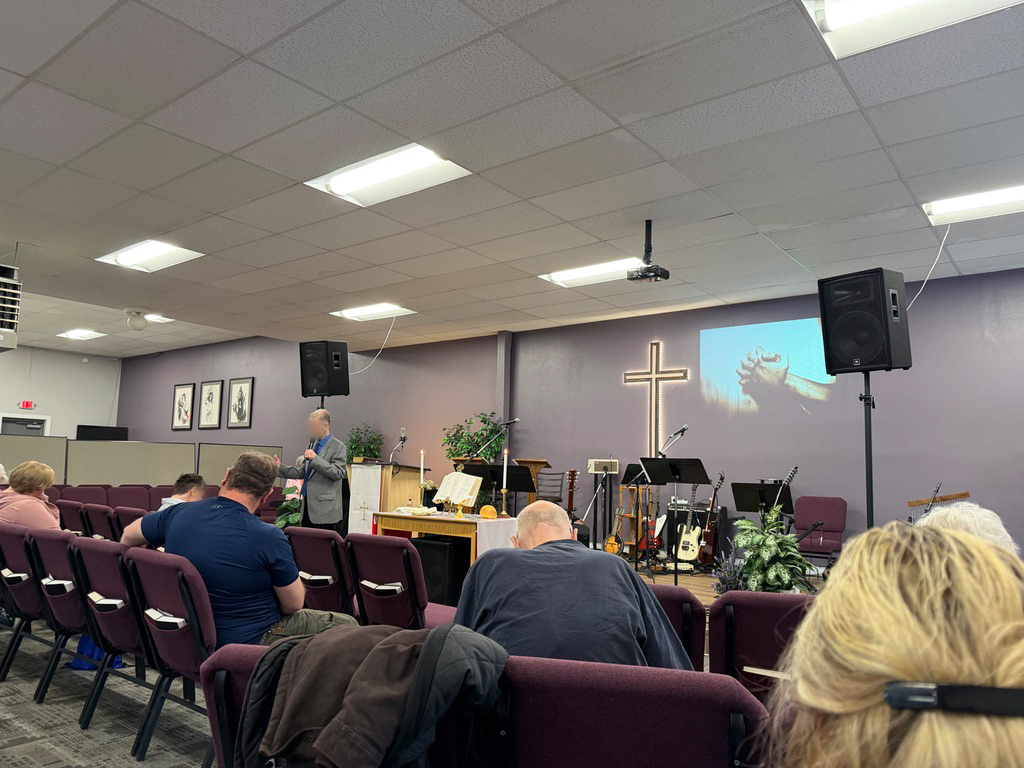
05. Community observations. The research team spent 2-3 weeks in each research site, embedding in local life and attending community events and gatherings. These observations were intended to situate individual attitudes within broader social, cultural, and institutional contexts. This included: Public facing civic meetings, such as a county library board meeting; Church services across a range of Christian denominations (e.g., Evangelical, Baptist, Methodist) and congregation sizes; Regularly scheduled meetings, dinners, and breakfasts among local political organizations, whose members included elected officials, public servants, and community leaders; Community service activities that participants regularly attended or facilitated; Community-specific events including a cattle sale, running club, a gun show; Informal "hangouts" among participants and the friends and family with whom they most talk politics; Visits to local 'watering holes' where politics and civic life get discussed, incl. local bars, coffee shops, and diners; Drive-arounds with some participants in which they highlighted community sites, landmarks, and landscapes that play a role in shaping their political beliefs.
WHERE WE WENT AND WHY
We selected three counties as fieldwork sites, chosen for analytical diversity rather than statistical representativeness. They were selected to maximize variation across dimensions likely to shape how democracy is experienced: geography, economic structure, religious tradition, and the proximity to / density of physical touchpoints with public institutions.
We selected counties as our organizing unit for two reasons. First, the county is the right scale for ethnographic work: small enough that people share considerable civic infrastructure (e.g., courts, health departments, libraries, etc.) but large enough to contain real internal variation across participants' lived experiences and day-to-day infrastructure (e.g., neighborhoods and church congregations). Second, counties are a common unit around which local political activity organizes in the United States. Consistent with this, many of the conflicts that activated participants in each site, such as Ottawa Impact's takeover of the Ottawa County Board of Commissioners, Campbell County's library board controversy, and Greenville County's growth politics, took place at the county-level.
THE THREE FIELDWORK SITES WERE:
Campbell County, Wyoming (Gillette area). Known as the Energy Capital of the Nation, and home to the Powder River Basin coal fields that produce roughly 40% of American coal, 87% of Campbell County voted for Trump in 2024. The county has also seen the rise of the Freedom Caucus. Anti-government ideology coexists with structural dependence on federal land policy and energy markets. Visiting Campbell County let us study conservative distrust in a place where self-reliance is less ideology than infrastructure, and where federal energy policy has become a material fact of life.
Ottawa County, Michigan (Holland/Grand Haven area). Historically Michigan's most Republican county, Ottawa County has a deep Dutch Reformed tradition, a mixed economy of manufacturing, agriculture, and tourism, and a recent county government upheaval organized around the "Ottawa Impact" coalition. It remains heavily Republican (59% voted for Trump in 2024), but with persistent Democratic pockets and a fast-growing population. Ottawa County let us study conservatism in a place where institutional conflict is fresh, faith is central, and the question of what counts as "real" conservatism is actively and sometimes bitterly contested.
Greenville County, South Carolina. South Carolina's most populous county and the economic hub of the "Upstate" region of the state, Greenville has grown dramatically since the 1990s. Home to Bob Jones University and a large evangelical community, it is a site where the church provides civic infrastructure that often takes precedence over formal democratic institutions. Rapid growth has brought new residents (transplants) and new prosperity, while longtime residents describe being priced out of a community they helped build. We selected Greenville to understand how conservatives navigate democracy in a context shaped by Southern traditions, strong Christian culture, multiracial community dynamics, rapid economic transformation, and tensions between newcomers and longtime residents.
HOW WE RECRUITED PARTICIPANTS
We recruited seven primary participants in each county for a total of 21, across a range of ages, incomes, education levels, and political self-identifications. All self-identified as conservative, Republican, or both; all but two voted for Trump in 2024 (these participants did not vote, but intended to vote for Trump; one was in the hospital at the time and the other had to work and expected Trump to win her state regardless). The sample includes 11 men and 10 women, ranging in age from their early twenties to mid-seventies.
Participants were recruited using a framework recently developed by the SNF Agora Institute at Johns Hopkins University and Public Agenda, which finds that conservatives' attitudes towards democracy can be largely categorized according to responses to a single question: Should the president be able to ignore court rulings if they believe doing so is in the nation's best interest? Responses to this question reveal conservative Americans split roughly evenly into three distinct groups: those who answer yes (believing presidential action can supersede judicial authority when necessary); those who answer no (prioritizing constitutional constraints and checks and balances even when they disagree with outcomes); and those who answer unsure or don't know (holding more ambivalent views on institutional authority and democratic norms). We used this framework in our recruitment survey, resulting in four respondents who answered "yes," five who answered "no," and 12 respondents who answered "I'm not sure." We deliberately over-indexed on participants who fit this last category to dive deeper into the beliefs, values, and contexts that they negotiate in deciding when to swing "yes" versus "no."
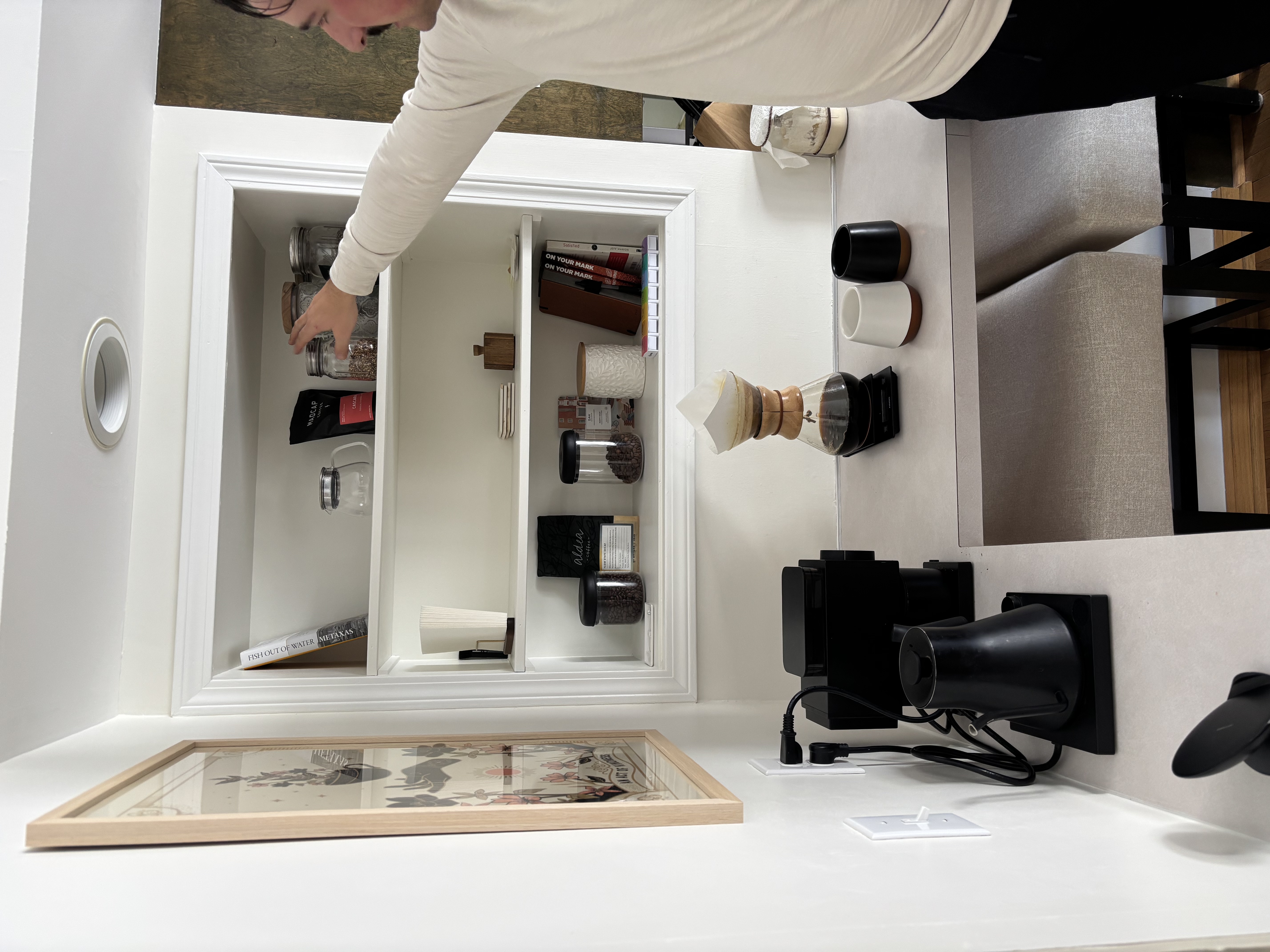
The sample reflects considerable attitudinal, civic, and lifestyle diversity. Participants range from Reggie (late 20s, SC), who cast his first vote just months before we met him and sees democracy as a recoverable ideal; to Clint (mid 70s), a retiree in Michigan who stays up until midnight watching legislative sessions online, has concluded the system is already too far corrupted to repair through democratic processes like elections, and whose basement houses thousands of books organized by subject (Catholic apologetics shelved beside sections on communism and radical movements) alongside long-term survival supplies. Maria (60s), a nonprofit founder in Michigan, volunteers as a court-appointed child advocate, but distrusts every institution she can name; Edgar (early 20s), a college student studying architecture, arrived at conservatism through the philosophical teachings of Aristotle and Tocqueville, not church. Between them sits a wide range of other participants: lifelong Republican party loyalists who have voted straight-ticket Republican for decades, alongside disillusioned former Democrats, alongside participants who have quit both parties and now describe them as "on the same team"; participants drawn to RFK Jr.'s critique of corporate medicine and institutional public health, alongside those for whom conservatism is almost entirely organized around fiscal and constitutional concerns. In Sam's polished, millennial-coded home, the decor and coffee setup (a Chemex, gooseneck kettle, and pour-over filters) would look right at home in a Brooklyn loft; in the small rural home Kyle rents on his gig-worker wages, the interior is sparse other than a flag that reads "I <3 Jesus" hanging above his bed.
This heterogeneity is itself a finding: the label of "conservative" is today embraced by Americans with a wide range of ideological and democratic orientations as well as lived realities.
On several dimensions, the sample generally tracks broader national conservative and Republican population measures: income distribution mirrors Pew's Republican breakdown, with a quarter of respondents earning under $50,000 and a third earning above $100,000; gender is near parity at 52% male, 48% female; and evangelical and non-denominational Christians constitute roughly 40% of the sample, consistent with their share of the Republican coalition nationally. On the study's primary variable of interest tolerance for democratic norm deviation the full range is represented, from high to zero tolerance. We intentionally skewed towards participants who were "unsure" about norm deviation, underrepresenting folks who are both strongly pro- or against.
The sample skews more educated than Pew data on the broader conservative electorate. Respondents with a four-year college degree or higher account for 62% of the sample, compared to approximately 35% of conservatives nationally. The skew is not uniform, and the gap is most acute for our Greenville sample: in Campbell County, Wyoming, four of seven respondents hold only a high school diploma, broadly reflecting the county's working-class, energy-economy profile. In Greenville County, South Carolina, no respondents hold only a high school diploma, despite that group comprising approximately a third of the county's adult population.
The skews around both education level and tolerance for norm deviation likely affect how prevalent specific findings are within the broader conservative population. We hypothesize that, for example, the Foundation Defender segment (detailed later in the report) may be larger in the broader conservative population than our sample suggests; and that generally levels of grievance may be slightly understated across the report. Other core findings detailed later in the report, such as the moral foundation, institutional trust taxonomy, and the finding about how norm deviation is morally justified, hold across the full sample and do not seem to be contingent on education level.
All participants were compensated for their time and have been assigned pseudonyms. No real names or identifying details appear in this report.
Key Terms
Several terms in this report carry meanings specific to its purposes. Some differ from their common usage. We define them here before they appear in the text.
Democracy/Democratic: Unless otherwise noted, we use "democracy" and "democratic" to refer broadly to any form of government where political power is vested directly or indirectly in the people through competitive elections. However, among our participants, the term is contested, and its meaning is contextual. Many prefer "constitutional republic" to "democracy" for reasons discussed further in Chapter II. We use both terms descriptively throughout the report without endorsing any particular definition of what democracy requires. While democracy has become partisan-coded in many contexts, we intend all of these descriptors to be neutral.
Norm deviation: Actions that push against or cross the conventional limits of democratic participation: challenging institutional authority through extra-legal channels, supporting leaders who bypass conventional checks and balances, or endorsing actions that democratic practitioners would classify as violations of procedural norms. Our participants largely do not see these actions as outside the bounds of legitimate democratic behavior. Often in civil society this is referred to as "democratic norm-breaking." We are using "norm-deviating" in pursuit of more neutral terminology. While conservative populations are the focus of this research, we do not believe norm deviation is unique to conservatives, and recognize that there are many on the left of the political spectrum who support (and participate in) norm deviation.
Conservative: "Conservative," "Republican," and "Trump voter" are related but not interchangeable terms. "Conservative" typically describes an ideological orientation, whereas "Republican" describes a partisan affiliation. In this document, we use "conservative" to refer to our participants (see section above on "How we recruited participants" for more detail on how they self-identify, their voting behavior, and their responses to recruitment screening questions). As such, the term refers primarily to self-identification (as either a conservative, Republican, or both) and self-described voting behavior and not an ideology throughout this document. We explore ideology and issue positions ethnographically to understand the diversity that exists under the labels of conservative and Republican.
The moral foundation: The value system we found our participants use to evaluate political, civic, and institutional questions. It is organized around four pillars Faith, Family, Freedom, and Place and is described in depth in Chapter II. While the weighting and texture of each pillar varies from one community and individual to the next, the foundation reflects patterns observed across the ethnographic data.
The three-tier mental model: The way we found our participants understand democracy: their moral foundation at the base (Tier One), formal democratic institutions and processes in the middle (Tier Two), and informal democratic norms at the top (Tier Three).
Sacred institutions: Democratic institutions that participants believe to be direct embodiments of their core principles of good governance, and thus inviolable. On the whole, participants don't believe that there are many left.
Corrupted institutions: Democratic institutions that participants believe to have abandoned (or are working against) the core principles of good governance (detailed in Chapter II), but can be opted out of and are therefore avoidable.
Hostile institutions: Democratic institutions that participants believe have both abandoned those governance principles and are unavoidable meaning that citizens cannot opt out of or choose alternatives to them. An institution can be seen as corrupted without being hostile.
Actor critics: The segment of participants who see democratic crises primarily as problems of bad actors in otherwise sound institutions. Generally these participants believe elections can fix said crises.
System critics: The segment of participants who see democratic crises as structural: democratic institutions themselves have drifted from their constitutional design. Generally these participants believe elections alone cannot fix said crises.
Foundation defenders: The segment of participants who see democratic crises as civilizational: the moral foundation itself is under existential threat. The problem extends all the way down to tier one of the three-tiered mental model of democracy.
Introduction &
Executive Summary
This study examines how conservative Americans in three counties — Campbell County, Wyoming; Ottawa County, Michigan; and Greenville County, South Carolina – experience and evaluate democracy
The Central Argument
Conservative Americans are not anti-democratic. They hold deep, sincere commitments to democratic ideals — to elections, to the rule of law, to freedom of expression, to constitutional government. But these commitments are filtered through a moral framework — what we call the moral foundation — that differs substantially from the liberal democratic framework dominant in elite institutions.
When conservatives appear to support anti-democratic behavior, it is typically because they have concluded that democratic norms are already being violated by their opponents — and that defensive action is justified.
How This Report Is Organized
Chapter I — Relationships to Democracy. Documents how conservative Americans understand and relate to democracy, including the three-tier mental model.
Chapter II — The Conservative Moral Foundation. Describes the four pillars (Faith, Family, Freedom, Place) and how they shape political interpretation.
Chapter III — The Great Decoupling. Analyzes the three channels through which conservatives feel increasingly estranged from mainstream institutions.
Chapter IV — A Segmentation for Conservatives' Tolerance for Norm Deviation. Presents a three-part typology: Actor Critics, System Critics, and Foundation Defenders.
Chapter V — Potential Implications and Further Research. Offers strategic frameworks for stakeholders seeking to engage with conservative communities.
Relationships
to Democracy
Our data might appear on the surface to validate accounts of conservatives as antagonistic to democracy. 14 out of 21 participants in this study had an immediate negative reaction when asked about democracy. Sarah (mid 30s, WY), a homeschooling mother, put it plainly: "I don't like the word democracy." Clint (70s, MI), a retiree, was equally direct: "[Democrats and liberals] talk about our democracy. We don't have a democracy yet. If we do, it'll be a problem... [democracies] often start as republics, and then they devolve to democracies, then they turn into tyranny and / or anarchy." During an exercise in which we presented respondents with a range of scenarios that represent a deviation from democratic norms, ranging from firing investigators accused of politically motivated bias to restricting press coverage and challenging legitimate election outcomes, nearly every conservative we met supported at least one deviation.
However, three weeks of immersion in these communities revealed substantive commitments to democracy even among those who reject the term or support democratic norm deviation:
The people we met are invested in American civic life, though to varying degrees: Most participants engage in civic life through everyday channels, such as voting (though not always consistently), following the news, attending church, and talking politics with neighbors and family. A subset go further without holding formal positions: Ben (early 30s, WY) knows his mayor by name and reaches out directly when he has concerns, describing local government as the one level he still trusts to listen. Jordan (early 30s, MI) reads local ordinances, watches city council meetings, and is considering a run for local office reasoning that if the system is worth preserving, someone has to show up and do it. A small handful are formally active: Matthew (40s, SC) leads a nonprofit serving veterans and has spent years cultivating relationships with government officials he considers genuinely good at their jobs. The appetite for civic participation runs through the broader communities they live in as well: at a Wyoming Governor's public budget session our researchers attended, two young people (one in high school, one in college) walked to the microphone to ask how they could get more involved, and the room broke into sustained, spontaneous applause. A local organizer immediately followed them up to announce that Campbell County had just published a list of 250 ways for residents to participate in civic life.
They also express reverence for the founding design of the American government: In free word-association exercises, many participants spoke with deep reverence for the constitution. Thomas (40s, SC) called the Constitution "great, genius what has made us a great country for 250 years." Reggie (late 20s, SC) called it the document that "separates us from every other nation in the world." Clint (70s, MI) described it as "the bedrock of the type of government that we have... Checks and balances were built into the Constitution to provide longevity and a balance so that nothing would get out of whack." Steve (60s, WY), a military veteran and small-business owner who believes civil war may be "the only way to repair the country," centers constitutional protections, the Electoral College, and accountability to constituents in his vision of what good government looks like. Patricia (50s, SC), a financial controller, explains: "If I've got to choose from humanity's governments across the planet, I'm going to choose America each time and twice on Sundays."
Across our sample, the depth of the conviction that the republic's key features exist to protect against "majority rule" varies: Participants like Clint (70s, MI), Jordan (early 30s, MI), and Patricia (50s, SC) can articulate specific structural features of the republic and explain why they matter. For others like Steve (60s, WY) and Sarah (mid-30s, WY), the preference is felt strongly but is less theorized. For at least one participant, Sam (early 30s, MI), the republic-versus-democracy distinction is largely semantic.
SO WHAT'S GOING ON?
Most consider America a constitutional republic, not a democracy, and view this distinction as fundamental rather than semantic. These participants are drawing on a distinction that is technically accurate: The United States was designed as a constitutional republic, not a pure democracy. In participants' telling, the republic's key features: elected representatives who exercise judgment rather than mirror popular will, constitutional rights beyond any majority's reach, checks and balances, federalism, and the Electoral College, exist precisely to protect against an "excess" of democracy that they call "majority rule" or "tyranny of the majority."
Most participants believe that the cultural conditions necessary for a viable democracy no longer exist. A 'true' democracy of untrammeled majority rule would require a population with shared values, shared realities, and the capacity for self-governance conditions they feel America has lost. Participants' fear of majority rule might appear at odds with their support for Trump, a leader who ran on the populist claim of speaking for the people against a corrupt elite. But these views are one and the same. They do not perceive Trump as speaking for what they see as the majority: liberal Americans, mostly coastal, urban and suburban, whom they distrust deeply. (Most see this group as the cultural and institutional majority, holding outsized cachet and authority; participants are more mixed on whether they also see them as the numerical majority.) They see Trump as championing rural, small-town Americans, who they believe are marginalized by this majority and are the defenders of the moral foundation.
While some participants reject democracy as a concept, for others the critique is more practical: democracy requires conditions America no longer has. For American democracy to be truly viable, they argue, Americans would need to be a unified people with a common moral foundation, enough shared reality to reach agreement, and citizens capable of governing themselves together. "If you destroy the way that people think, if everybody's thinking different," Reggie (late 20s, SC) says, "you can never have democracy." Shirley (mid-30s, WY), a preschool teacher's aide, attributes the rupture as explicitly linked to secularism. "We were all under a Christian nation. Now we are not. We're so far off that we have no common denominator anymore as Americans."
For many participants, this degradation is concentrated on the left: a handful of participants struggled to answer when asked whether Democrats had morality, and a few said directly that they did not. The more prevalent pattern was an asymmetric moral map: individual Democrats were sometimes extended the benefit of the doubt, more commonly characterized as misled than evil, but the party as an institution was described as having abandoned the theological and moral foundations that, for these participants, make democratic life possible. While for a few participants this sentiment veers towards a rejection of pluralism or even a desire for Christian nationalism, most are expressing a concern that is shared across the political spectrum: an anxiety about a citizenry that increasingly cannot agree on values or even facts.
Some participants take this concern about the electorate's fitness for self-governance further. Clint (70s, MI) believes Americans across the political spectrum though especially voters on the left have become passive, distracted, and manipulated through politics' "bread and circus" (what theorists call manufactured consent) and thus lack the civic virtue required for self-governance under democracy. To him, the "bread" is welfare expansion, open borders, politicians over-promising programs to buy votes; the "circus" is social media, disinformation, and emotional political messaging engineered to inflame rather than inform: "People can be whipped up into emotional fervor through psychological operations and you can get them to make bad decisions." Jordan (early 30s, MI) views this as more of a generational problem than a partisan one: "Hard times create hard men, hard men create good times, and good times create soft men, soft men create hard times. And I think we're kind of in the soft men part of that."
Given this, protecting the constitutional republic is experienced as an essential insurance policy.
In the absence of moral consensus across Americans, the structural guardrails of a constitutional republic are what stand between participants' way of life and the majority rule they believe would dismantle it.
Sarah put this directly, "I don't value democracy, because we wouldn't be heard. Wyoming's the smallest state on the map, right? If we were a democracy, then we wouldn't have a voice." Kyle (mid 20s, WY), a delivery driver, extends the logic: "Every single small town would be outvoted by every single city. We wouldn't be able to feed people cows. We'd all be eating seaweed." Patricia (50s, SC) offered up a common conservative metaphor: "[Democracy is] two wolves and one sheep deciding who's for dinner. I hate that word [democracy]. I mostly hate it when people who think they are educated about our style of government use it to say, 'Save our democracy.' No, there's no democracy here. Praise God. If there were then California and New York would make all of our electoral choices." Steve (60s, WY) describes it directly: "Democracy rules... is mob rules, okay?"
Many participants also see a republic as a critical structure for protecting against the whims of the American population. One of the great benefits of a republic, multiple participants point out, is that it enables elected officials to exercise independent judgment on behalf of constituents, drawing on information and context their constituents don't have. Kathy (70s, SC), a semi-retired resident, scarred from decades as a resident of big cities such as Denver and Atlanta, highlights that "majority rule is also very unstable, because the majority fluctuates."
Participants believe the slide toward “too much democracy” is well underway.
For many participants, the slide is synonymous with Democratic Party capture. The word "democracy" has itself become evidence: it now conjures both "majority rule" and "Democrat," and the two have merged into a single threat. Democracy, as they see it, has become the vehicle through which the left has embedded itself in institutions DEI mandates, voting rights expansion, progressive figures now embedded in schools, public health, and media. For Clint (70s, MI), Democrats' own rhetoric is the clearest signal of this: treating "our democracy" as a rallying cry is itself a confession of intent to dismantle the republic's guardrails.
Others point to structural signals. They see a coordinated effort to lock in a permanent left-leaning majority: the creeping elimination of the Senate filibuster, and most viscerally, what they believe is a deliberate reengineering of the electorate itself (e.g. voter rolls they claim are kept full of dead people and non-citizens, and an immigration policy they read as a pipeline to Democratic votes). During a free association exercise, Patricia (50s, SC) jumps immediately to themes of corruption when prompted with the word: "elections." "We have known for decades that there is corruption within the registration system," she says. "The Biden administration gave social security numbers to 3 million different illegal aliens who then got voter registration cards."
For Matthew (40s, SC), the drift is cultural as much as structural: He says people now expect their Congressional representatives to "do a direct poll for every [legislative] vote" pure democracy by another name, and in his view a profound misunderstanding of what a republic is designed to do. "Put your finger in the wind to see which way it's blowing... that's actually a disservice to the office."
Participants argue the left has captured the institutions that shape what Americans believe before they ever cast a vote: institutions such as K-12 schools, universities, media, and public health, have all become vectors for pushing progressive values. Clint (70s, MI) and his wife call it the "raging river," a cultural current so powerful it has pulled their own children from faith and conservative values into an amoral progressive agenda, fracturing their family in the process. Together, Clint and his wife attend a weekly group at their church Catholic women who gather to pray for children who have wandered from the faith.
For Reggie (late 20s, SC), the stakes are more philosophical. He believes that the "woke" agenda doesn't just shift political opinions, it dissolves the objective truth that democracy should require. "What does that do to our society if there's no objective truth? If everybody can [have their own truth] like what if the guy kills someone, well what was his truth there's no structure."
What unites these concerns is the fear that the American government has come untethered from the moral foundation it was built on.
Our participants believe the American republic was always conditional on a particular moral order that has now been lost, and a people who held enough in common to uphold this order together. Political philosophers distinguish between popular sovereignty (authority flows from the people's will), constitutional sovereignty (authority flows from founding documents), and in some traditions, divine or natural law sovereignty (authority flows from transcendent moral order). Our participants' fear of "too much democracy" is, at its root, a fear that popular will or procedural legitimacy have become misaligned with and elevated above the moral order that should orient both. They believe popular will and procedural legitimacy are important, but can become illegitimate when they stray too far from or threaten the moral foundation. Thomas (40s, SC) captures the hierarchy at stake when he says: "Democrats see government as their God, while conservatives see their God as God, and government as sort of secondary."
The Three Tier
Mental Model
of Democracy
The perceived decoupling of the moral foundation from the democratic system destabilizes a three-tiered mental model of American governance.
The fear that the American government has become untethered from its moral foundation is, in this model, a fear that Tier 1 and Tier 2 have separated. When that happens, Tier 2 loses its claim on loyalty, and Tier 3 is the first thing participants are willing to let go. Crucially, arguments about the sanctity of democratic norms tend to land poorly for this reason: norms sit at the top of the hierarchy, the most expendable tier, and are understood by many of our participants as customs that politicians invented for their own benefit rather than for the benefit of the republic. The real weight is at the base of the model.
The
Conservative
Moral
Foundation
The conservatives we met share a moral framework that precedes and judges all other aspects of life, including democracy itself. It is organized around four pillars: Faith, Family, Freedom, and Place. The relative importance of these pillars varies across participants, with Faith often being particularly dominant. In our participants' view, these pillars constitute the core of a good and moral life. Democratic institutions, processes, and norms are evaluated against this moral foundation rather than abstract theories of how democracy should work. Institutions that they believe serve this moral foundation earn trust; those that they believe threaten it lose trust. This framework is distinct though complementary to Jonathan Haidt's moral foundations theory. Haidt describes the how of moral reasoning, identifying six psychological building blocks: Care, Fairness, Liberty, Loyalty, Authority, and Sanctity. He finds that liberals tend to draw primarily on care and fairness, while conservatives draw more evenly across all six foundations, with particular weight on loyalty, authority, and sanctity. Our four pillars describe what conservatives hold sacred, i.e. the domains (Faith, Family, Freedom, Place) to which mechanisms like loyalty, authority, and sanctity attach.
This moral framework is visible in how participants talk about and describe themselves. Matthew (40s, SC), a community leader and veteran advocate, describes himself as a Christian first, a conservative second, and a Republican third. His faith, he says, "would trump the conservative and Republican, because it filters everything else."
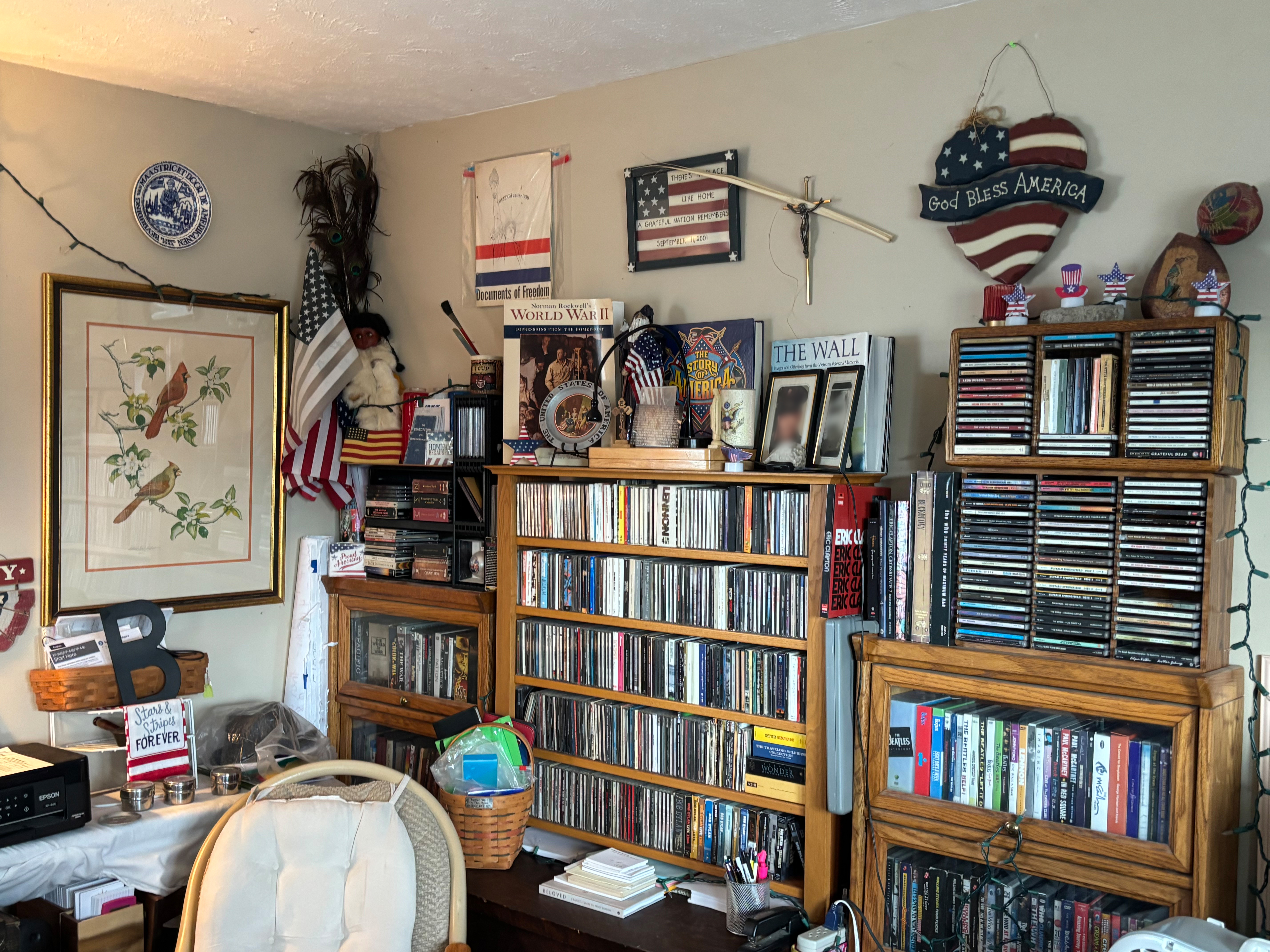
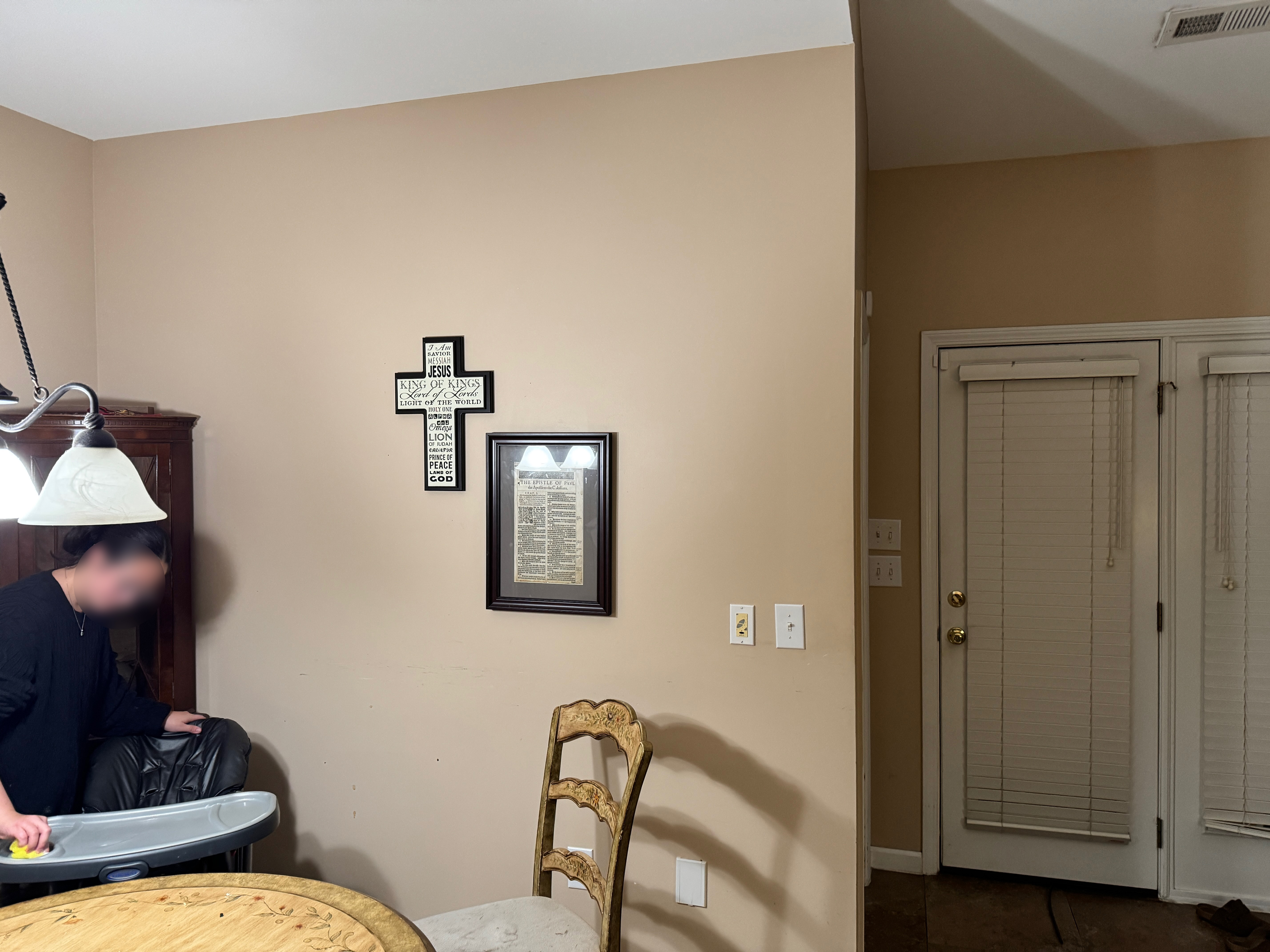
This moral foundation is also enshrined in the material culture of participants' lives, highlighting how aesthetics and lifestyle choices reinforce belief and identity on a daily basis. Trump signs and party paraphernalia were rare inside participants' homes. Instead, what fills their spaces are crosses, prayer charts, family photographs, scripture on reclaimed wood, hunting trophies, and images of the communities people were born into. Hannah (late 20s, MI) had stickers all over her laptop, including a leopard-print cross, a map of Michigan made into the shape of a machine gun, and one with history's bloodiest dictators extolling the virtues of gun control. Linda (late 30s, SC) has a whiteboard on her fridge that reads "be courteous, be aware, be reasonable" a family motto that she says doubles as her political framework. In Maria's (60s, MI) apartment, a single shelf arranges a cross at the apex, an American flag beneath it, and religious books as the foundation a visual hierarchy that enacts her conviction that civic life is downstream from God.
Television and radio do the same work. The TV shows Yellowstone and Landman center multigenerational families defending their land against outside forces; country and Christian music cover themes such as truth, God, rural community, and freedom. Taken together, these constitute a daily, ambient reinforcement of participants' moral foundation.
Faith
For most participants, Faith is the foundational pillar of their moral foundation. They hold God as the ultimate authority and lone source of a single, objective truth sitting above the Constitution, democratic consensus, and public opinion. Rights, in the view of many of our participants, are not granted by the government; the government merely recognizes rights that are already God-given.
Reggie (late 20s, SC) explained this clearly and calmly, conveying his conviction as a man of deep faith: "The only objective truth is God's Word, and I stand on it, because there was no moral law before God. The first recorded law was from God's word. All ethics originate from scripture." Patricia (50s, SC), an eighth-generation Greenvillian, traces this idea directly to the country's founding. She expressed to us, urgently, "Our framers Thomas Jefferson specifically said this style of government only operates well within a faith-based community. When you remove faith and faith-thinking people operating within those systems, you got a problem. Mayday!"
For these participants, legitimate authority flows downward from God rather than upward from popular will. This is most readily captured by transgender politics, which surfaced for many of our participants as a direct violation of the Faith pillar: an assault on what they believe to be God's objective truth that there are only two genders. Meanwhile, democratic processes, outcomes, and norms that they believe contradict divine order carry limited moral weight regardless of their formal legitimacy. For Maria (60s, MI), the primacy of faith had material consequences on her party affiliation. She remembers the 2012 DNC as the moment she knew she would never vote Democrat again - specifically, she recalls Antonio Villaraigosa choosing not to open the convention with a prayer. The precise memory is somewhat off: the actual controversy centered on God being removed from the draft party platform, with a contentious floor vote (marked by audible booing) to restore it. But her emotional read of the moment holds: "The Dems have denied God. That's how I interpreted that."
Multiple participants in our study told stories of the church having a profound impact on their lives. For Kyle (mid 20s, WY) and Sam (early 30s, MI), it offered a path to responsibility, belonging, and purpose at moments when they had none: Kyle found moral grounding in the church after a period of anger, isolation, and unresolved trauma; Sam broke from depression and over-drinking after a near-drowning at the edge of a lake, and discovering through faith that "all that anxiety, depression, all that pressure in my life just kind of fizzled away." Sarah (mid 30s, WY) credits the church with rescuing her family from hardship when she was ten feeding her, housing her, accepting her, and surrounding her with people who treated her with dignity for the first time. Her story is the most precise illustration of the trust and loyalty many of our participants hold in the church, and the impact this can have on politics. At eighteen, she told her boyfriend's parents she might vote for Obama: "He cares for people, like, my mom's a single mom. We grew up poor. He wants the best for us." Her future in-laws didn't argue. They listened, and asked: "Who did care for you? Who brought you out of poverty?" Sarah's answer was not the federal government it was her church community. "It was literally the hands and feet of Christ." In the years that followed, every public institution she encountered schools, hospitals, the federal government failed to replicate what the church had given her as a child. She has been a firm conservative ever since, steadily moving further right with time. When researchers attended Sarah's church with her, they saw how the church continues to provide a meaningful sense of community, with Sarah spending nearly half of the two-hour visit greeting friends and neighbors.
A small minority (3 of our participants) hold faith more loosely. Just one, Eric (40s, MI), says he wouldn't identify as religious at all. For these participants, Family and Freedom carry the weight that Faith does for more religiously-driven participants.
Family
The second pillar, Family, flows directly from faith for most participants. They hold that there is a natural social order a set of concentric obligations in which the nuclear family is the basic unit of society, and responsibility radiates outward from there: from self, to family, to church and neighbor, and only lastly to the state. They see the protection of unborn life and parents' rights to govern their children's education as non-negotiable moral convictions rather than policy positions.
Core to this pillar is the idea that providing for and protecting one's own (whether that's children, household, community, or simply one's self) is an obligation, not a preference. Dependence on institutions to do what you should do yourself is, in this framework, a form of moral failure.
For parents, this imperative is most visible in decisions about children's education and health. Sarah (mid 30s, WY) homeschools her children. This is a choice rooted in what she witnessed during her own teaching career: fifth graders "having sex... drug problems... kids cutting in class and showing their arms off after they come out of the bathroom." Today, Sarah has dedicated an entire room of her house to homeschool her children filled with books, musical instruments, a computer, and toys she picked out to create a values-aligned learning environment. Similarly, after years of her young son's seizures going undiagnosed by neurologists, Sarah has leaned into the world of MAHA (Make American Healthy Again), investigating his symptoms on social media and making significant changes to the family's diet and health practices over the last five years based on what she's learned from influencers and other moms online. She says her son's seizures have drastically improved since she identified what she believes is a likely glutathione deficiency, which she believes is triggered or worsened by Tylenol, red food dye, and chlorine. Her kitchen - stocked with peptide containers, bone broth packets, other homeopathic supplements, and the number for a local chiropractor reflects this shift towards self-directed care informed from outside traditional healthcare institutions.
Per the concentric obligations mentioned above, self-reliance is only part of this Family pillar. Social responsibility is also a genuine moral obligation but with limits, given the moral imperative to first provide for and protect one's own. Just as important is who takes on this responsibility: when community members do need help, that responsibility belongs to the church and neighborhood, not government programs that displace the relationships they were meant to support.
Louise (late 20s, WY), a homeschooling mother, articulates this as a theological structure. She believes there are different spheres of influence, from God to family to church to government, each with its proper role. "The problem that I see with some politics is they take the government and they try to put it in place of God... that then puts everything else out of whack." She sees her church's giving as both more effective and more meaningful than state redistribution. "Not only does it mean more, but there is more to go around than if it goes to the government." When her furnace broke in a blizzard, two neighbors came to fix it without being asked. For Louise, that moment exemplified the ideal model: a system of mutual aid rooted in proximity and shared values.
For Reggie (late 20s, SC), the nuclear family is sacred because he has seen loved ones suffer when it breaks down. His half-brother is facing several years in prison and his half-sister cycles through homeless shelters, which Reggie attributes to their father being largely absent from their lives. Reggie's own father forged a high school diploma to get work, held three jobs through a temp agency, and stayed present for him: "My father was always in my life and I couldn't say the same for everybody in [my community]." Rachel, Reggie's wife, frames what he is protecting in theological terms: "One is trying to hold to the original design that God had in place, which is the nuclear family - right, like one man one woman and procreating because those are blessings from the Lord." Within this nuclear family framework, Reggie tries to be the man and father he believes his family needs: he wakes at 4am for devotional time before anyone else is up, plans to homeschool their young daughter, and consumes podcasts and e-books that center familial-Christian themes - "Courageous Parenting," "Raising Godly Boys," and "The Journey of a Christian Dad." Reggie's social responsibility extends outward, too: on Wednesday nights he runs youth ministry, in his words "filling in for homes that don't have parents." But government welfare, in his view, actively corrodes the family structure he so values creating a financial incentive for women to stay single rather than married, and substituting dependency for self-determination. Though Reggie believes it's acceptable to, for example, use food stamps temporarily and in a crisis, he views any sort of long-term dependence on welfare programs as a trap, and a form of political control: "You're kind of letting them make you, depending on [the government] so they can get what they want out of you."
Freedom
The third pillar is Freedom. Freedom, as most participants see it, is the individual's right to be left alone: in body, family, property, faith, and thought, without institutional and state interference. At its core is a commitment to personal sovereignty: participants believe they not only have the right, but a moral duty to be "truth-seekers." This means doing their own research, maintaining skepticism of formal institutions, and contradicting mainstream consensus when the evidence warrants it. Having the courage to think independently, rather than defer to experts, is itself experienced as an expression of freedom.
Beyond cognition, the body is perceived by participants as one of Freedom's most intimate domains. If the government can mandate what goes into it or what it does in public spaces, there is, in their view, no principled limit on what else it can mandate. This logic was especially salient in responses to the COVID-19 pandemic. Liz (mid 30s, MI), a former social worker and stay-at-home mom, makes the connection explicit. "My body, my choice, you know? I just find it to be like a kind of opposite and upside down world sometimes. The vaccine helps you and protects you. If I don't get it, aren't you still protected?"
This orientation toward bodily autonomy has extended into skepticism surrounding public health and food institutions, espoused most directly by the MAHA movement. Participants increasingly see US food and health institutions (such as the FDA and USDA) as failing to protect them from food-based harms, and are taking matters into their own hands. Maria (60s, MI) read ingredient labels aloud during our interview. "If you can't read the first five ingredients, it's fake," she says. Liz's (mid 30s, MI) kitchen follows the same logic: Ezekiel brand bread on the counter, a cayenne-ginger-turmeric shot in the fridge. Sam's (early 30s, MI) kitchen runs on grass-fed beef, locally roasted coffee, and no seed oils. For many of our participants, institutional distrust is reinforced day-to-day via empirical scrutiny of their own and their family's exposure to potential harms. Freedom, meanwhile, is asserted through alternate consumption choices a domain that often feels more legible to participants than government institutions. Liz struggles to say what the Senate does, but she knows what's in Ezekiel brand bread.
Hannah, (late 20s, MI), traces her distrust of mainstream medicine tied to her wider distrust of institutions back to childhood. Watching her father nearly die of heart failure in second grade led her to pore over peer-reviewed nutrition studies in her early teens. But when she suggested healthier school lunch options to her principal, he told her he agreed but had no power to change it. She eventually rejected mainstream medicine altogether in adulthood after a holistic doctor solved with lifestyle modifications what a conventional doctor said could only be managed with medication.
Sam (early 30s, MI) and his wife, who identify as "big fans of [Health Secretary] RFK [Robert F. Kennedy]," have opted out of traditional insurance in favor of a Christian health cooperative: "We don't have traditional healthcare... we essentially have a monthly premium and our money goes in the pot," paying $350 per month combined versus $700 per person under the government insurance marketplace. The savings are real, but this choice is also an assertion of freedom from an insurance market Sam views as corrupt.
For Hannah, gun ownership is the most literal expression of Freedom. She holds the Second Amendment as the right that protects all others, and views its purpose as explicitly to give citizens the ability to resist state overreach: "The Second Amendment is designed for the intention to prevent a tyrannical government." She has turned that conviction into a career, working first as a firearm salesperson before building her own firearms instruction practice, focused on educating younger generations about the Second Amendment.
How this pillar is held varies across the study. For some, freedom from government mandates on individual behavior is the dominant pillar of their moral foundation. They value individual sovereignty and the government staying entirely out of their personal lives. Jordan (early 30s, MI), who turned down his COVID stimulus check and three weeks of unemployment after a recent layoff on the same principle, holds a strict line against accepting government funds: "Nope, never will. I do not want money from the government." Ben's (mid 20s, WY) home is a testament to his autonomy sitting on an acre of land, powered by its own propane tank, and with a photograph of Sitting Bull, who Ben says he admires for taking a stand against government interference in his life, holding a rifle in the living room.
For Eric (40s, MI), who identifies as gay, freedom from cultural coercion and excess is just as sacred. This is strongly informed by his family history: his mother's family fled a communist regime when she was five, losing their businesses and all of their possessions. Government agents even tried to take his young mother's earrings at the airport. His grandmother equated the entire Democratic Party with communism calling Jimmy Carter a communist and Eric has extended this thinking to contemporary figures like AOC. For Eric, the defining feature of communism isn't economic it's the removal of individual freedom through collective imposition, by state or by culture; by that logic, any felt coercion of cultural norms is a step toward a regime like the one his mother fled. "I don't think you should shove anything down anybody's throat, even gay," he says applying the same principle to Pride that he applies to vaccine requirements. In a card-sorting exercise on democratic norm deviation, he placed Pride alongside January 6th as, in his mind, equivalent examples of cultural spectacle and self-expression gone too far: "We could put Pride in here, too. We could put January 6th [next] to Pride... Yes, I see it as equivalent."
For Kathy (70s, SC) freedom is something "invisible, like a fish lives in water" - so ambient and God-given she barely needs to name it, until something punctures it. In her view, COVID did this not just through government overreach, but through the way ordinary Americans became enforcers of federal control, assuming license to police one another over what she felt were overblown anxieties. "I just wasn't that freaked out about it... I just didn't think that my life depended on it." Kathy tells the story of going to a Trader Joe's while in Colorado during lockdown. The sidewalk outside was stenciled with pairs of feet six feet apart. When Kathy stepped off her mark, the stranger next to her immediately confronted her "She almost had a meltdown" and in doing so, came close enough to Kathy that it set her up for a dry rejoinder: "Oh, please do not come any closer to me."
For other participants, the claim to freedom is more bounded: they believe that within the family sphere what their children read, learn, eat, and are exposed to parents hold authority, not institutions. Library books, school curricula, employer policies, and environmental toxins that override that judgment are, in their view, intruding into a domain that does not belong to them. For Maria (60s, MI) and Edgar (early 20s, SC), the pillar functions differently. They talk about freedom, but their core concern is moral order, and freedom is only worth protecting insofar as it serves this. They are willing to use government power to restrict freedoms they consider morally corrosive and antagonistic to their core pillar: Faith.
Place
The fourth and final pillar, Place, is the conviction that one belongs to a specific community, land, or founding inheritance that cannot be legitimately taken, sold, or remade by forces that didn't build it. It operates at two levels: the local community, landscape, and economy; and a national connection to the country's founders as kindred people who worked the land and governed themselves, whose legacy now feels like it is slipping away for many of our participants.
Connection to land and nature was a core tenet for some, particularly in Wyoming. Elaine (50s, WY), a rancher whose spread sits under multiple federal jurisdictions, noted, "You'll see a lot of ranchers that don't go to church. They call this [their ranch] their church." Rather than religious symbolism, Elaine's home is filled with art and artifacts commemorating "ranching life," with silhouettes of rodeo riders, paintings of cowboys, and furniture made of wrought iron and rustic wood adorning her house. Sarah (mid 30s, WY) lives in a more suburban setting within Campbell County, but her home is similarly filled with references to the land, and she is deliberate about her family living in a way that reflects and honors their rural surroundings. She began paying attention to local politics during the pandemic, over a chicken ordinance prohibiting residents within city limits from keeping chickens. With fertilizer missing from store shelves and eggs in scarce supply, the rule struck Sarah as a faulty application of urban policies onto a rural context. Today, the chicken ordinance has been overturned due to local activism, and her family sources all of their eggs from a chicken coop in their backyard. The ideal of neighborhood-scale self-sufficiency travels beyond Wyoming, even when the connection to land itself is less strongly held. Hannah (late 20s, MI), a firearms instructor in Ottawa County, shares the vision "If a couple houses on the block had gardens in their backyard, you'd have enough produce for the entire neighborhood" - though for her it remains more aspiration than practice.
The pillar also helps explain attitudes toward wealthy transplants, undocumented immigrants, national associations, and federal agencies alike. In participants' framework, the place local or national - belongs to those who built it, endured its hardships, and accepted its obligations.
Kathy (70s, SC), who left Atlanta after being priced out, now watches the same dynamic arrive in Greenville. She spent fifteen minutes describing all of the things that she loves about Greenville: the walkability, the Swamp Rabbit Trail, Paris Mountain Park, the restaurants, and the genteel Southern character. But "in ten years," she laments, "Greenville will be Atlanta... A lot of people will not be happy with that... A lot of people in Greenville think we're already full... I understand that I was one of those people that contributed to that." She pauses for a moment, recognizing the irony in her words that one might consider her to be among the same type of gentrifying transplant that she resents. "In 10 years, it'll probably feel less like home... but I'll probably be dead by then."
For many participants, the change is not just cultural but financial. Jordan (early 30s, MI), a tradesman whose grandfather built the house he grew up in, describes the housing market flatly: "You're paying $400,000 on a house that's worth $150,000." He cannot afford to buy a house there anymore, and traces part of the cause to investors: "There are some people who own five houses... they own them to rent them... you're not able to buy them because somebody is making money off of it." Patricia (50s, SC) describes her resentment towards newcomers from blue cities who move into Greenville and push agendas that serve their interests rather than the community's.
“It's always coming from those that weren't born and raised here, that were born and raised outside of the south, from Democrat cities with that kind of mindset.”
"This is not the library I grew up in," Patricia tells us from inside the main Hughes branch of the Greenville Public Library. The Hughes branch is bigger and bolder than what stood there before, a proper selling point for a city that has remade itself around a decades-long downtown revitalization; Patricia recognizes that it's a beautiful upgrade. But mostly, she sees the library as a symbol of a transformation she not only paid for with her tax dollars, that has brought with it the displacement of long-term Black and Hispanic renters from downtown Greenville. Patricia directly links this displacement to the homelessness that now surrounds the library. "We've got a homelessness issue. You can walk around this library and see it and smell it."
This emphasis on belonging and rootedness may seem at odds with the growing role that transplants have come to play in conservative local and state politics over the last decade relocating from blue to red states in search of political and cultural alignment, and in cases like that of Campbell County, becoming among the most vocal participants in local party structures, school boards, and Freedom Caucus-aligned organizing. (See the "Community Contexts" section of Chapter IV for more on this.) Participants who support these candidates don't seem to have a principled way of rationalizing this; rather, they address it on a case-by-case basis. When asked how she reconciles the importance she places on local rootedness with her support for Wyoming Freedom Caucus members who moved in from out of state, for example, Sarah dispels this claim, pointing out that the representative in question's in-laws are from the area: "They homesteaded it years and years and years ago."
The Foundation in Practice
Aspirational, not behavioral: A candid reading of these four pillars and their application to ideas of government requires acknowledging that they describe an aspirational framework rather than a behavioral one. Participants rarely live them out perfectly, and some acknowledge this. Kyle, who identifies as a devout Christian and frames his entire worldview through faith, watched a viral video of an ICE agent taunting a protester "I love this. I would do this for free" - and when asked about it, doubled down: "It's funny, whatever, shock value." The same tension appears collectively: participants at a local gathering place in Campbell County described Wyoming legislators who publicly claim Christian identity while engaging in coordinated online harassment of political opponents "You guys all claim to be Christians, but you don't act like that."
This gap between aspiration and behavior is perhaps most visible in how participants talked about racial and religious minorities, and about gender. The Faith pillar produced a sincere commitment to treat all people as equal across nearly all participants many referenced Christian universalism and expressed genuine reverence for Martin Luther King Jr.'s "content of character" framing. The majority expressed skepticism toward racial redress reparations, DEI, and the premise of ongoing structural racism but consistently framed this as an expression of that same aspiration: a defense of colorblind meritocracy rather than a rejection of equality. In about a third of participants, however, the stated commitment sat in tension with how they talked about specific people and groups. This took different forms: primarily dismissive characterizations of public figures and racialized language or stereotypes. For example, one participant dismissed Justice Ketanji Brown Jackson as "a DEI hire as far as I'm concerned," using a derogatory nickname in doing so. Several participants also showed researchers anti-Muslim or anti-trans content they had circulated on social media. Participants commonly couched such content as irony, loosely-held belief, or as entertaining someone else's more extreme belief. These cases suggest that for at least a subset of participants, the universalism aspiration is most readily activated toward people experienced as part of the same moral community, and less consistently toward those perceived as outside of or threatening to it.
Weighted differently across participants: Our sample is far from monolithic. The four pillars - Faith, Family, Freedom, and Place are present across the sample, but they do not apply in exactly the same way for every participant. What gives each person's foundation its specific texture and hierarchy is the intersection of community context, information ecosystem, and direct institutional experience described in Chapter IV. Faith tends to be more load-bearing in communities where the church functions as genuine civic infrastructure. Freedom takes on particular intensity in Campbell County, where livelihoods depend on the right to extract natural resources from federal land: for Ben (mid 20s, WY), a former coal miner and Army veteran, his skepticism of federal government came from older miners who had watched their livelihoods be reshaped by energy policy cycles long before he ever stepped foot in a coal mine. Family anchors the moral foundation most urgently for participants who have watched institutions make decisions about their children and families that they believe are not those institutions' to make a grievance that sharpened acutely for many participants during COVID. Place is sharpest for those who have watched their communities change faster than they chose. The values and threats most present in a participant's information ecosystem also shape which pillars feel most urgent and most endangered. So do direct encounters with institutions, which convert abstract pillar commitments into lived conviction.
Taught, but also reinforced by personal experience: This moral foundation is learned explicitly and implicitly through church sermons, family conversations, and schools, as well as accumulated ambient culture. But some of the most emotionally and politically charged expressions of the moral foundation are often the result of broader ideological commitments coming together with specific lived experiences. For example, one participants' concern about graphic content in sex education books and novels located in the children's and middle school section of her local library - including a book she described as detailing a young girl's repeated sexual abuse is anchored in her own childhood trauma, and a related fear of overexposing her children. "When I read that book, it was traumatizing for me, because as someone who has been through something like that, seeing those images, or reading those words, it brings [those memories] up in my own mind." Another participant's strict pro-life position (no exceptions for rape or incest) rests on her sister-in-law being the child of a rape. For one man in our sample, his views against abortion crystallized after he and his girlfriend experienced a stillbirth, began IVF, and learned his insurance would not cover the IVF but would cover an abortion. A woman in our sample became steadfast on the importance of the Second Amendment proponent during her first marriage, facing a husband who "started to become aggressive and even a little bit physically violent." She drew the conclusion, "I should probably buy a gun and learn how to use it."
Holds major sorting power: Some of the views participants expressed around topics like abortion, LGBTQ+ issues, or recent ICE tactics (framed as enforcing rule of law) that exist in direct tension with the values Americans elsewhere on the political spectrum hold. For example, the majority of our participants were strongly opposed to abortion, and experience this as a core belief around which there is little room for negotiation. On gay marriage and LGBTQ+ issues, most participants said they accepted gay individuals, but drew increasingly firm lines around what they perceived as institutional promotion and children's exposure, with trans issues for minors approaching the same level of near-universal opposition as abortion. It warrants calling out explicitly that these topics hold major social sorting power, capable of dividing Americans into distinct and incompatible information ecosystems (see Chapter IV) and serving as dealbreakers for connection or compromise across political divides, thus driving affective polarization. This creates a fundamental tension for democracy practitioners with divergent beliefs: attempts to rebuild trust and connection both with conservative populations and across partisan divides will require acknowledgement of and respect for the conservative moral foundation yet core elements of this foundation may be experienced by progressives as incompatible with their own moral commitments.
What Good Government Looks Like
The moral foundation underpins five principles of legitimate government shared by our participants:
01. Government should be kept small: Large, distant institutions are wasteful, structurally prone to corruption, and detached from the communities they govern.
02. Power should be held close: Governance works best at the state or local level, and/or when it feels close and human through e.g. visible and accessible faces attached. This helps ensure that those making decisions can be held accountable to the people affected by them.
03. The Constitution should be treated as the binding standard: The Constitution is believed to have defined proper limits on government power, in addition to enshrining what participants see as key aspects of Freedom: rights, free speech, elections. Amendments and reinterpretations layered on top erode what was originally designed.
04. Government's domain is the protection of rights and the maintenance of order, not the provision of welfare or the shaping of culture: When it moves beyond that domain into administering care or regulating private behavior, it doesn't just fail to help; it's seen as actively encroaching and displacing the people and institutions that would be better suited to play a role. When it comes to welfare assistance, for example, the church knows who in the congregation is struggling and why. Care without this relational context is administration, and administration is not care.
05. Rule of law is a critical guardrail: The rule of law provides structure, stability, and clear boundaries that prevents chaos and the disintegration of America's society and morals. Rule of law is also viewed as supporting a core aspect of Haidt's moral foundation fairness particularly when it comes to topics like immigration. But this principle only holds for participants insofar as the laws themselves are seen as rooted in constitutional authority and moral legitimacy.
Each principle maps directly onto the pillars. Small government applies Faith and Freedom to institutions: a large state displaces God's authority and the individual autonomy Freedom requires. The desire for power to be kept close to the community applies Place to governance: Local people know their communities; federal bureaucracies don't. The Constitution as binding standard embodies the Freedom pillar: it enshrines individual rights and holds the founding inheritance as a living limit on institutional drift. Church and community as the safety net reflects Faith and Family: care belongs in relationships, in the proper order of spheres, not in administrative systems. Rule of law operates as the Freedom pillar's procedural floor: without it, neither individual liberty nor the moral order can hold. Participants apply these principles as a test to almost every democratic institution they encounter.
Still, the weight participants assign to each of these four pillars varies, and with it their ideas of good government. The sharpest tension in our sample exists between Faith-dominant participants who want the government to enforce moral order, and Freedom-dominant participants who distrust the government even when it is working in their direction. Edgar (early 20s, SC) for example, supports "a large, centralized government that is enforcing certain morals on a society. Because I think that ultimately there are things that are good for everybody." In practice, for him, this means the government restricting abortion, incentivizing nuclear family formation through pro-natalist policy, and treating Christianity as the proper moral foundation of American law. Ben (mid 20s, WY), in contrast, believes: "If that stuff goes too far, you can end up sort of infringing on other people's rights," before adding, "I really don't think there should be a whole lot of religion in policies." Ben smokes marijuana in Wyoming, where it remains illegal, as a matter of personal principle. When the conversation turned to conservative communities where religious values have shaped local enforcement people arrested for marijuana possession in Idaho, for example Ben responded with visible discomfort. His discomfort with perceived state overreach extends equally to the government enforcing Christian norms as it would to the government enforcing progressive cultural ones.
Sacred, Hostile, and Corrupted Institutions
These principles for good governance help explain participants' categorization of different institutions as Sacred, Hostile, or Corrupted. Before introducing their logic, it's worth noting that our participants do not, for the most part, distinguish between public institutions (government agencies, regulatory bodies) and private ones (corporations, media companies, pharmaceutical firms) when assessing whether an institution is trustworthy. They tend to associate institutions with power, money, scale, and distance much more so than any specific ownership type. For Elaine (50s, WY), "greasy palms" describes both congressional votes and pharmaceutical pricing. Jordan (early 30s, MI) is the notable exception his libertarian framework actively celebrates private enterprise and reserves distrust for government specifically.
| Category | Institutions, e.g., |
|---|---|
| Sacred | Supreme Court |
| Hostile | CDC/federal public health authorities, FBI/DOJ, IRS, Department of Education |
| Corrupted | Mainstream media, Science and academic “experts,” Elections (Corrupted in practice; Sacred in principle) |
SACRED INSTITUTIONS
A sacred institution directly embodies the governance principles: small, rooted in rule of law, it feels 'close to the people' insofar as it is made up of recognizable humans who can be held accountable in the court of public opinion, constitutionally grounded, non-intrusive on family and community. The current Supreme Court is the clearest example for many participants - nine justices who together embody the idea of meritocracy, not a sprawling bureaucracy, deriving authority from the Constitution rather than current political will, each knowable as an individual accountable for specific decisions. Kyle says, "By the time you get to [the] Supreme Court, that is like the last line of defense. Most often they have somebody that earned their way in there... from what I've seen, it seems like the Supreme Court is usually pretty effective." That human-scale, personal accountability the sense that a small group of highly accomplished people with names and records are answerable for specific decisions, in contrast to, for example, the structural accountability of checks and balances is precisely what agencies like the EPA, the IRS, or even Congress are seen to lack. There are not many institutions that pass this test. The extent to which this trust in SCOTUS is conditional on composition or outcome-alignment warrants further exploration: for several participants, their trust in SCOTUS did hinge explicitly on composition, and a 6-3 liberal majority would likely dissolve the reverence quickly.
HOSTILE INSTITUTIONS
A hostile institution is one that is seen as using its authority against the moral foundation carrying coercive power into the most protected domains of daily life and does so in ways participants cannot escape. The CDC during COVID arrived in participants' bodies, their children's classrooms, and in their workplaces with mandates and no option to opt out. The Department of Education shapes curriculum in schools that children are legally required to attend. The FBI can open investigations, seize property, and destroy reputations. The IRS is among the most unambiguously hostile institutions brought up by our sample. Taxation is seen as coerced extraction from property with no exit a direct violation of the Freedom pillar's core promise that the government leaves you alone in what you've built. "The first two to three months of the year, you are working strictly for the government. That is infuriating," Patricia (50s, SC) tells us. The return she sees on that investment confirms that the extraction is not serving her: DOGE's exposés of government waste struck her as "mind numbing... infuriating... anger inducing." For Hannah (late 20s, MI), resisting this institution goes back to America's founding: "That's why we started a new country, right? It was like a 4% tax, and now the government's taking like 30% of our paycheck." The roads, she adds, are still full of potholes.
CORRUPTED (BUT NON-COERCIVE) INSTITUTIONS
Between sacred and hostile sits a third category: institutions that participants distrust but can choose to avoid. Mainstream media is one example. It is widely regarded as biased and detached from participants' foundational values, but participants can engage with alternative sources, avoid certain channels, and build selective information diets. Academic and scientific "experts" fall into this category as well, for many of the same reasons. Participants regard these institutions as corrupted, i.e. biased, agenda-driven, and untrustworthy, but ultimately less urgent to reform than hostile institutions because participation is optional.
How the Moral Foundation Squares with Trump Support
President Trump applies this sorting strategically positioning himself as attacking the institutions participants have identified as hostile, protecting the ones they regard as sacred, and persecuting those they see as corrupted. Understanding his appeal requires applying a different test than the one applied to institutions: it is not who he is, but how he protects the moral foundation.
As a person, most of our participants believe he fits the moral foundation imperfectly at best. Rarely did participants in our sample see Trump as morally infallible. Maria (60s, MI) came the closest of anyone in our sample: She has been watching Trump since she was 15 and claims, "He has never lied yet." However, most did not; even Maria, a few hours later, doubled back on her original claim, saying, "I do see him on TV selling his watches. So I don't know." Thomas (40s, SC) acknowledges Trump is "not very Christian" and that January 6th was "idiotic... stupid." Kathy (70s, SC), who has voted for him three times, says, "There are so many times that I just want to tell him, 'Shut up. You're not helping." Kyle (late 20s, WY) remarks, "Do I think Trump's all the time, great? No." He is also not, for most participants, a truth-teller in any conventional sense.
“I don't like him as a person, but I like him as a president.”
What Trump passes is a protector test, not a character test. When Trump was elected, Sarah's (mid 30s, WY) husband, a land surveyor, went from near-unemployment to being overwhelmed with work orders overnight the Place and Family pillars in the form of a paycheck. Trump's reversal of Biden-era restrictions on coal mining have made him nothing short of a hero in Campbell County Wyoming: when researchers attended a local "Governor's Listening Session" featuring a Q&A with Wyoming's Governor Mark Gordon, one woman took the microphone to describe how it "warmed her heart" to see coal mines operating as she flew into the Gillette airport. Similar protector sentiments surfaced in South Carolina. Thomas (40s, SC) credits Trump for being, in his mind, the only politician "saying yes to destroying these terrible criminal organizations," seeing cartels as a direct threat to Family and Place. Maria (60s, MI) sees Trump as a sort of holy contractor - "He came to do a job, he's going to do the job, and he's gonna split" and frames his dedication in almost vocational terms: "We know we can call him at 3 a.m. And he will be up." She also refers to his actions including the bombing of Syria, moving the U.S. embassy in Israel to Jerusalem, and advocating for a crackdown on insider trading as biblical fruits: "His fruits are what are proof."
This protector logic also helps explain how participants reconcile Trump's governance practices with the principles outlined earlier. On the surface, there is a contradiction: participants say they want small, local government bound by constitutional limits, yet they support a president who governs from Washington, has expanded executive power, and attacks rule of law institutions. But most participants do not see it this way. The governance principles describe an ideal state. Trump's aggressive use of federal power is justified as a necessary response to hostile institutions that have already violated their constitutional mandate. When the FBI investigates Trump, when the CDC mandates vaccines, when the Department of Education influences local curricula, participants believe these institutions have exceeded legitimate authority. Responding with equal force is not breaking the rules; it is defending the foundation the rules were meant to protect.
Whether this protector logic is about Trump specifically or about the presidency as a role is a question our data answers only partially, and warrants further exploration. Multiple participants describe the presidency as the only office with sufficient power to take on the federal institutions they regard as hostile. But unlike any other President, Trump has survived impeachments, indictments, and assassination attempts while continuing to fight a track record that serves to deepen some participants' trust in him specifically.
“Do I think Trump's all the time, great? No. But I do think he's fighting for everyone right now. I really do. He's doing a whole lot more than being a president. So as he's crossing these boundaries, that's why they're like, well, let's go ahead and try to get him arrested. Then he beats that.”
HOW IT APPLIES TO OTHER POLITICIANS
Many participants apply a similarly functional evaluation to other politicians, but focus more on perceived authenticity and consistency: Does what you do match what you claim, and do you hold that position when it costs you something? The asymmetry suggests participants draw a distinction, if only implicitly, between a protector (Trump) and a politician. A protector's job is to fight for the moral foundation. A politician's job is to govern on behalf of the moral foundation and in line with their promises, something participants verify through voting records and public behavior. For both, holding this position even when it comes at a personal cost earns trust.
Reggie (late 20s, SC) talks about this assessment in the context of politicians who invoke faith in the deeply religious communities of the Upstate to win votes: "People can play the part temporarily to get what they need... [but] actions speak louder than words."
Sarah (mid 30s, WY) keeps a phone album of her State Senator's voting record, assembled screenshot by screenshot from the state's legislative website the heartbeat bill, a mask and vaccine discrimination bill, medical prescriptions for off-label use. Sarah describes the Senator as well-liked in her community: his family is generous, his wife volunteers at the local Christian school, they attend a prominent church. When neighbors say they love him, she opens the album. "People will be like, 'Oh, I just love him' And I'm like, really? What do you love about him? And they'll be like, 'Oh, he goes to my church. He values life.' And then I'm like, 'then why did he vote like this?" Sarah applies this same 'practice what you preach' test to local Freedom Caucus politicians she knows personally, but because they pick up the phone to explain their choices when she calls, she often interprets their votes more charitably and with context in mind: "This actually gets me in trouble sometimes, because people are like, 'Well, you didn't know the language. I voted down that bill because it wasn't strong enough."
Louise (late 20s, WY) voted for a local Freedom Caucus candidate she openly disliked over a moderate she found more pleasant after she overheard the moderate candidate tell two different people opposite things about a library book controversy at a local ice cream social.
Clint (70s, MI) watched the Ottawa Impact county commissioners a far-right coalition that ran on a platform of local accountability and conservative governance take office and fail to uphold these principles: "They came into power and we had hopes that they would really do some great things, and they mucked it all up because they talked a good game. It was virtue signaling... they came in so rigid and ideological that it was our way or the highway and they just steamrolled their way through everything." The consequences were substantial: lawsuits, wrongful dismissal settlements, hundreds of thousands of dollars in county costs. This is the advice Clint now gives to candidates before they run: "Determine your non-negotiables before you run for public office. If you don't have any non-negotiables and you get elected, everything is negotiable and will be and you'll sell your soul to the highest bidder."
Matthew (40s, SC) has built his political trust through years of direct observation rather than stated positions. He works at a local nonprofit and notices which politicians actually show up. They cannot campaign there, but they can come and talk, which makes attendance a genuine signal rather than an opportunistic one. The officials who have shown up consistently, solved specific problems when called, and answered texts at short notice have earned his trust.
The four pillars and the institutional sorting that follows are the structure within which participants evaluate democratic institutions and norms. The same participant who holds genuine reverence for the Constitution and the Supreme Court can simultaneously support aggressive action against the FBI - not inconsistently, but by applying the same framework to two institutions that occupy different positions within it. The same logic explains why norm deviation that targets hostile institutions is not experienced by participants as a threat to democracy, and is sometimes even seen as a defense of it: the moral foundation precedes the system, and the system is only worth protecting insofar as it serves that foundation.
What this chapter has not yet explained is how the separation between the moral foundation and the democratic institutions meant to protect it became so acute. That process is the subject of the next chapter.
The Great
Decoupling
Channel 1. Community Context
Community context is the shorthand we use to describe the local, physical, and social fabric of people's daily lives, including the relationships and spaces through which values are formed, political identity is forged, and democratic institutions are experienced. Among other roles, community context transmits political beliefs and distrust of institutions across households and generations sometimes before any personal encounter with those institutions occurs and establishes norms around what's acceptable to believe and express around politics.
WHAT’S HAPPENING?
Within our sample, local conservative communities and identity appear to be splintering, all while productive political dialogue is disappearing. The church has moved to fill the civic vacuum, becoming the primary space for community, truth, and making sense of the world for many of our participants. In doing so, it has gained a trust and authority that no other institution in these communities currently holds. That authority increasingly entrenches the belief that government has become untethered from the moral foundation.
In all three counties, norms are tightening, the cost of political expression has risen, and public disagreement has come to feel like a character trial, fragmenting the conservative ingroup from within.
Today, terms like "RINO" - Republican In Name Only "liberal" and "Marxist" are now regularly deployed as insults by conservatives to refer to other conservatives. In Campbell County, this dynamic has a specific and traceable origin. The Wyoming Gun Owners Association (WyGO), a Wyoming chapter of a national network, started targeting local Republican politicians by name on Facebook starting around 2015-2016: tagging them in posts, circulating false claims about their records, and running paid advertising with graphics that invited followers to put specific people in their sights. The targeted politicians received threats by text, phone call, and Facebook message at such a high volume that law enforcement was brought in to investigate.
In a small community where everyone knows everyone, the effect was immediate and chilling: “It was so loud and so overwhelming scary for anybody to say anything against,” one former state legislator told researchers. “We’re still facing the consequences of what happened in 2016.” The cultural shift WyGO introduced was later consolidated by the Wyoming Freedom Caucus through formal loyalty pledges - signing or refusing to sign became the line between Republican and RINO. One local described the result as follows:
“If you have an independent thought, you’re a RINO. If you don’t vote as instructed, you’re a RINO…If you talk about a tax of any type, even for the roads. [People will say,] ‘Oh, you’re a liberal, you’re a RINO… I’m not sure who the person is who decides what the instructions are’.”
Similar factions replicated the phenomenon in the other two counties — the Freedom Caucus in Greenville, Ottawa Impact in Holland.
The boundaries of who belongs to which faction are not always clear, and participants often can't locate themselves with confidence: nearly every participant we interviewed called someone else a RINO, and everyone could point to others more extreme than themselves. What's clear is that none of our participants felt comfortable with this dynamic. More moderate conservatives in our sample felt censored and alienated by it, highlighting how the RINO label collapses any partial disagreement into total moral failure. For example, when Matthew (40s, SC) and his pregnant wife chose distanced seating at their church during the pandemic, their congregation labeled them liberals; at the same time, Matthew's colleagues at work considered them insufficiently cautious. Meanwhile, more right-leaning participants described being labelled as extremists, "crazies," or condescended to by so-called 'RINOS.' One community member described being dismissed by representatives from the American Library Association and feeling as though they discounted the value and wisdom of his lived experience because he didn't match their formal credentials: "I have a Master's Degree in life. I've almost died twice, I was a former addict." Similarly, Sarah (mid 30s, WY) described feeling boxed in by others in the community after supporting the Freedom Caucus' platform publicly in a local controversy. "I'm painted with this brush, and I can't, no one can see me outside of [it]. Now I can't just have a voice in my community because I stood up for something that impacts me." One consequence of all of this is that the Republican label is losing its force: participants increasingly identify as Conservative before Republican. This level of community conflict and in-group fragmentation feels relatively new to participants, a development of the past decade that they interpret as an extension of polarization. As a kid, Matthew (40s, SC) watched his deeply conservative parents put a Democratic candidate's lawn sign in their front yard. The candidate was a local solicitor they admired; their vote was an endorsement of the best person for a specific job, not a statement about identity. "It can't always be wrong to support somebody on the other side, right? If it's the right person, that's the right person." Years later, Matthew worked for a Republican congressman who was labeled a RINO by many community members; a church member confronted Matthew in the parking lot and accused him of being one too. The same church member was present when we attended a Sunday service with Matthew the morning of his interview. Matthew admitted to us afterward that he was still stung and nervous around this individual more than a decade later: "I was hoping he wouldn't come talk to you."
Steve (60, WY) echoed this sentiment that the stakes have shifted: "There's no in between anymore... you're either a Christian or you're not a Christian, either a patriot or not a patriot." He added: "I didn't call Democrats non-Americans [ten years ago] either."
At the same time, formal civic spaces have come to be seen as increasingly hardline. Politics has migrated to the coffee shop, the church, the private text thread — spaces where political identity is validated among allies rather than challenged or examined.
A similar dynamic has reshaped formal political spaces in the communities we studied, as organized factions have pursued a greater role in local politics. In Campbell County, the Freedom Caucus targeted local party precinct committee positions filing candidates en masse and appointing allies to vacant seats until the Central Committee had shifted far enough that Wyoming's Governor Gordon and Senator Barrasso were openly booed at the 2018 state convention. Longtime precinct members who had run the system for decades now say they have no standing in the system; one told us she would "rather have her teeth pulled" than attend a meeting. In Greenville County, Matthew has largely stopped attending local Republican meetings: "The arguments are just not that inviting, like especially when it's people who should be friends." He says he's not alone. "The mainstream elected officials don't even go to these party events very much anymore. They want to stay away too." Multiple participants describe a similar cycle playing out in their communities: as moderates withdraw from formal political spaces, the spaces become more "extreme," and so moderates further withdraw, adding to a vicious feedback cycle.
The public norm in all three counties is increasingly political silence; the private reality is sorting, figuring out who can be trusted to say what can't be said openly. Linda (late 30s, SC) describes Greenville politics as "everywhere, nowhere" - yard signs combine with a selective silence in a culture where open confrontation increasingly carries real social and reputational costs. Clint (70s, MI) describes conservative conversations happening in church margins: "People sneak over and chat with me when other people aren't listening." Ben (late 20s, WY) is direct about the stakes in Gillette, "That's usually how a lot of people get fired at the mines. [Talking about] politics." His strategy is to avoid the subject entirely. "Just shut up, show up on time, do your job, and go home." Kyle (late 20s, WY) tells us of arguing with a drunk older man at work about the premise of "innocent until proven guilty" in the Gabby Petito case; the argument escalated until police were called. Kyle credits this experience as one of the last times he ever discussed politics openly in Gillette: "It's mainly older people [who talk about politics]. Younger people will be like, 'I don't mess with that...'" This experience, combined with the hostility of "Gillette Rants and Raves" on Facebook, soured him permanently on local civic engagement.
One clear risk of this is what sociologists call enclave deliberation: when like-minded people deliberate only with each other, it produces more extreme positions than heterogeneous discussion. It may also contribute to a derealization in politics where politics exists mostly on screens rather than in observable facts and meaningful, real-life interactions.
This comes at an additional cost to civic skills and local problem-solving.
Stories across all three counties suggest that people arrive at political engagement equipped with categories, insults, and screenshots rather than the habits of productive disagreement — compromise, listening, and the patience for incremental change. Sarah (mid 30s, WY) describes convening a local committee at her kitchen table three Democrats and three Republicans to develop a compromise around a local education issue. Though Sarah says her views on the topic were considered among the most "extreme" in the room, she offered up what she felt were reasonable compromises, like creating a rating system for books, or putting books with sensitive content into a special section that would require an adult's permission to access. Yet, Sarah told us the discussion collapsed because no one had the communication tools or skills to hold the conversation together. "They're not going to change their views if you try to have a conversation with them. What's the point of wasting my breath? I'd rather be in my resounding [echo] chamber with my friends."
Sociologists also describe this as the atrophy of bridging capital the working trust across groups that makes democratic bargaining across differences possible. The same challenge applies when it comes to navigating local incidents around hot-button issues. Gender politics came to a head in Campbell County when it was revealed on social media that a magician who had been invited to perform for their children at the local library, chosen from an American Library Association-recommended list, was a trans woman. Protests ensued, with signs carrying messages like "God Hates F**s," and the magician receiving death threats; ultimately she cancelled her performance. While locals who commented on this event to researchers felt it was reasonable that parents in a conservative, rural town might have questions and discomfort around this prospect and some level of processing would ensue, many felt the explosive reaction was "malicious," and blamed it on a small group of local "extremists" with whom they didn't want to be associated. This incident illustrates what can happen when the local infrastructure for talking through charged political topics becomes strained: even the prospect of difference gets captured by the most extreme framing before any genuine encounter can take place.
The church is stepping in as a primary civic institution, one increasingly organized around the message that democratic government is misaligned with the moral foundation.
As conservative community life fractures around in-group conflict, the church has moved into the civic vacuum and come to be seen as one of few remaining spaces for in-person community — fueling the local shift from partisan belonging to moral belonging. Reggie (late 20s, SC) was one of multiple participants who described church as the only institution he still trusts in a world where he strongly distrusts the federal government, public education, healthcare, and universities.
Multiple forces seem to have shifted the nature of these churches' relationships to authority and politics in recent years. COVID played a major role: the decision to close or stay open during lockdowns turned churches into visible political actors. Sam (early 30s, MI), whose faith conversion has given him a community he described as life-giving, found that when the state said he couldn't gather, the local church that defied the order became the defining institution on his side. Matthew's (40s, SC) church offered multiple service options during COVID. Taking them up on that accommodation earned him the label "liberal" from fellow congregants who saw any flexibility as capitulation.
Denominational splits over identity issues like "The Methodist Split" from 2019-2024 have also contributed. Thomas's (40s, SC) church, once a coalition of liberals and conservatives, split in 2023 when, as he tells it, the national Methodist body (which was run by coastal Democrats) forced a choice on gay marriage and transgender inclusion.
In addition, across all three counties, participants describe migrating toward non-denominational and evangelical congregations away from institutional structure and towards both a communal focus and a more direct relationship with God and pastor. The consequence: congregations seem to be more politically homogeneous than before, and more likely to be organized around individual pastoral authority with little institutional layer above the local pastor as a moderating force. For example, Linda (late 30s, SC) left the Catholic Church for a non-denominational megachurch after experiencing what she saw as rigid institutional rules, seeking instead a "direct relationship with God." Shirley (mid 30s, WY) settled at an Evangelical church after leaving multiple Baptist congregations where she twice witnessed church boards abruptly removing pastors, ultimately drawn to a church with less institutional hierarchy and more "grounded in the Bible."
How politics is messaged inside these congregations varies widely. Steve's (60s, WY) church in Gillette hosts regular meetings for a local right-leaning organization in the same building where he worships every Sunday. Sam's (early 30s, MI) pastor in Holland explicitly avoids partisan politics. Louise's (late 20s, WY) previous church in Gillette teaches the neo-Calvinist "spheres of influence" - God, family, church, then government without ever endorsing a candidate. Her current church has gone further, banning political discussion within the congregation. Some participants told us their church leaders had endorsed specific candidates or positions directly from the pulpit. Others told us their church discouraged any political talk within the congregation. This matters because the church has long been extraordinarily effective at generating bonding capital: trust, community, and shared identity within the conservative in-group. But as congregations grow more politically homogeneous and explicitly political conversation retreats to the margins, they may produce less of the cross-group bridging capital that democracy requires. Across these variations, there are some stylistic similarities: The pulpit tends to deliver theological frameworks that carry political implications without stating those implications explicitly. When we attended a Sunday service with Matthew (40s, SC) and his family a 500+ person congregation gathered in a modern, recently-renovated building - we observed his pastor avoiding overt political or partisan messaging while building a narrative that Christianity is under threat, both abroad and at home. Couched in between prayers for a sick parent, a newborn, and a high schooler waiting on a college decision, we prayed for persecuted Christians in Libya, for a local crisis pregnancy center, and for Justice Sonia Sotomayor to rule "constitutionally," and not be swayed by worldly, non-Christian judgment. Matthew later told us this prayer rotation is repeated weekly, but the subject changes: the church cycles through a schedule of political leaders starting with the President and working down through the Supreme Court and other offices as well as countries in which Christians are being persecuted.
Alongside the pulpit, other channels sometimes deliver the content more directly. Kyle's (mid 20s, WY) pastor forwards him tweets about the Epstein files and demonic networks in a string of private texts. Participants also described church home groups and post-service conversations as places where topics like immigration, the library board fight, and election integrity are discussed more openly. When content operates through the deepest trust relationships these participants have, the political worldviews it produces carries more authority than anything a distant media source or democratic institution can deliver.
Channel 2. Information Ecosystems
The role of participants' information ecosystems media sources, platforms, influencers, podcasts, and algorithms - requires less explanation. This channel establishes participants' sense of political reality, while also setting the emotional temperature of politics and painting a picture of 'the other side.'
WHAT'S HAPPENING?
Amid growing distrust of mainstream media, conservative information culture has reorganized around a new epistemic identity: the critical, independent thinker who has done the research and broken free from corrupted institutional sources. But participants' replacement for institutional trust — seeking values-aligned sources (including some members of the political elite, e.g., Trump) and content, trusting their gut, and validating through social networks — can make participants more vulnerable to confirmation bias and informational epistemic bubbles. Participants end up seeing parallel portrayals of the same events covered in mainstream media, but with systematically different conclusions about what happened, what those events mean, and who caused them. The consequence is not just that participants distrust mainstream media, as such information ecosystems tend to reinforce the message that mainstream media institutions are fundamentally captured and untrustworthy. It's that the mechanisms mainstream institutions use to establish credibility — mechanisms like expert input, peer review, debunking and fact-checking — have no purchase in this new framework.
Note: It's worth noting explicitly that informational heuristics like seeking out values-aligned sources, network validation, and trusting one's gut are not unique to the right. Participants' skepticism of mainstream media as left-leaning also does have some empirical grounding: some surveys of mainstream journalists' political affiliations have recently documented a consistent and significant leftward skew.
Being an independent, critical thinker who seeks truth is increasingly central to conservative identity.
When we asked participants to describe their approach to news, the word "independent" surfaced consistently. This characterization informs both how participants interact with their information ecosystems today, and which types of sources they view as trustworthy. Notably, Fox News was not a source most participants were excited to claim: in line with their moral foundation, which highlights objective Truth as something that is God-given and thus essential to seek out, many take pride in going beyond mainstream sources, doing their own research, consulting multiple perspectives, and arriving at conclusions through their own judgment. Participants told us about the importance of being "awake" to manipulation, and not being duped by misinformation. Importantly, this did not necessarily translate to participants being distrustful of political elites; in fact, we frequently observed participants echoing the language of specific political elites in describing their own views.
Some participants defined being a conservative as seeing "both sides" or maintaining a "God's eye view" above the partisan fray a self-positioning resembling what researchers have called "diagonalism, " a rejection of the left/right political binary they document as commonly co-occurring with anti-institutional and even conspiratorial narratives. These narratives tend to be right-aligned, but they aren't always. Hannah (late 20s, MI), for example, applies her firearms expertise to determine whether she trusts reporting on major news stories involving gun violence, from mass shootings to assassination attempts on President Trump to Charlie Kirk's killing. When she posted doubts about the official account of Charlie Kirk's shooting on the CUTEservatives Facebook group a community started by Turning Point USA-affiliated media personality Alex Clark that Hannah discovered around 2019 and followed for years, even traveling for in-person events Hannah says she was immediately blocked, along with thousands of other users. The expulsion extended her distrust to her own political tribe: "That's where it started to click for me, of like not trusting my own party." Now that she's been expelled from this community, Hannah's trust has shifted to Ian Carroll, a creator whose hook is verifiability - starting with things you could walk into a supermarket and confirm. His citizen-journalist aesthetic grounded, skeptical of power, evidence-seeking - speaks to a generation of young conservatives who have abandoned cable news not for a new authority, but for the performance of inquiry: creators who show their work, teach you where to look, and let you feel like you arrived at the truth yourself. As Frank (60s, WY) puts it: "They're teaching you how to look and where they're looking so that you can go and find it yourself."
While some participants are more passive in their information consumption, many younger participants in particular are actively building this autonomous "independent thinker" identity. When Ben (mid 20s, WY) encounters a story on Facebook, he Googles it to find how different outlets frame it, compares those framings, and arrives at his own assessment. "People forget to take the time to research different angles, to gain their own viewpoints." While browsing his feed live in front of researchers, Ben saw a meme about the impending war in Iran on Facebook, and then went to Fox News and CNN to compare their coverage of the story.
Edgar (early 20s, SC) runs his diet through Ground News, an aggregator that assigns stories a 'bias distribution' according to the political lean of the outlets covering them, and allows readers to compare how sources across the political spectrum are framing those stories differently: "If Fox News says one thing, CNN says one thing, and Reuters says one thing, it'll basically create a combination headline." When coverage skews heavily toward one side, he pays attention: "If there's something that's like, 10% Republican and 90% Democrat, then I might be more inclined to take a look at it" - he wants to know what conservatives who only watch Fox might be missing. He also watches Nick Fuentes, who identifies as a Christian Nationalist, White Identitarian, and "the most cancelled man in America," not as a fan but to "try to ascertain, like, what is going on" with right-wing young men. Kathy (70s, SC) added Ground News to her media diet the week before our interview, after starting the media diary assigned to her by researchers, saying: "/ am trying to be very sensitive to the fact that... by the very nature of the internet and algorithms, you're prone to echo chambers. It occurred to me in the process of doing the media diary, I don't ever want to find myself being sucked in by that." The move seemed to be driven in equal parts by an earnest desire to counter epistemic bubbles and a desire to inoculate herself against how her media diet and views might be perceived by others. She expressed this anxiety directly that through the study she would end up "famous on TV, because look at this crazy woman in South Carolina who believes all this." This moment highlights that being an "independent thinker" and truth-seeker carries social as much as epistemic meaning for participants.
When the Epstein files were released, Liz (mid 30s, MI) went directly to the government document repository to explore them firsthand. She also tracked down J-Mail.world, a website recreating access to Epstein's Gmail account. "You can search his Gmail as if you're logged into his Gmail." She had to stop reading after spending too much time searching. "I had to put it down... Pizzagate is real. The way that they were talking in code it's beyond. It's like so bad that I can't even really touch it... The weeks leading up to this interview, I kind of spiraled about it. You see like different files come out and the code words that they use and also that the freaking current administration... is like they're protecting who is sending these emails."
Sam (early 30s, MI) grounds his approach in a motto: follow-the-money. He asks, "who is funding this outlet and what do they have to gain?" A college research project on the American Diabetes Foundation - which, he discovered, received major funding from Coca-Cola and, he claims, never mentioned sugar as a factor in diabetes became his operating framework for evaluating all media. "The mainstream media, they're funded by the big pharmaceutical companies. The big money donors are tied to the political parties historically in big ways. So, for me, I'm looking at that as like, well, can I trust what these news organizations are putting out?" When this heuristic reaches its limits, Sam watches for whether a source gives "anything a chance from the other side." He drops sources that never concede a point. He has cancelled his New York Times subscription in favor of independent podcasts and YouTube channels like Valuetainment, which he judges to be structurally independent of money-driven distortion. "I know they don't have the sponsors... he's not beholden... they don't take a big check from, you know... Coke."
However, Sam's migration to YouTube highlights that in practice, moving away from mainstream sources means greater reliance on social media, podcasts, influencers, and other independent sources only sometimes paired with local news. So while being an independent thinker feels to participants like escape from epistemic bubbles and low quality information, it can make participants more susceptible to both.
Kyle (mid 20s, WY) illustrates this as well. When searching for political news, he scrolls to the bottom of Tik Tok looking to find videos with the fewest views. "Sometimes I hear about stuff, and if I want the uncensored version, I'll go to TikTok and just scroll down to the things with the littlest amount of likes because they haven't been up [long] enough to be taken down." He avoids subscribing to any single channel "if I try to watch the same person over and over again, there's a good chance that eventually I'll become biased." But he also trains the algorithm by watching the recommended videos he likes to completion, and sometimes even watches them repeatedly. As a result, he believes he has engineered an information environment he experiences as maximally diverse. In practice, it is shaped entirely by an algorithm trained on his own prior engagements.
As participants use shared values as a primary verification criterion, some become deeply entrenched in the epistemic bubbles they aspire to avoid.
The information landscape participants navigate feels, to many of them, fundamentally unverifiable. Bias seems rampant:
“[News was] news up until the 1980s, then we went into a 24-hour news cycle and it became entertainment, and now news is political activism.” — Thomas (40s, SC)
Al is making things worse: Participants lament that deepfakes render video and audio evidence unreliable; Al-generated content floods platforms faster than any fact-checker (or sites like Snopes) can keep up with; and that they are unsure whether they can trust Large Language Models themselves. As Ben put it: "It is impossible to really nail down the truth in so many different ways, unless you're the guy on the ground doing it." Clint (70s, MI) sees this having major consequences for democracy: "Al is going to really screw up the politics because you can take a picture of you with your voice saying something that you would totally disagree with... that's happening right now."
Within this context of unverifiability, this "independent thinker" identity and rejection of institutional sources raises a major challenge: how do participants know what's true, or who to trust? The moral foundation plays a critical role. Not unlike others across the political spectrum, many participants determine what's credible by looking for values-aligned content and sources detected not just through what a source says about their beliefs, but also through emotional register, aesthetic presentation, and what the source or content intuitively makes them feel.
Hannah's (late 20s, MI) conservatism deepened significantly through the CUTEservatives Facebook group: "This girl ran a show called POPlitics [now Culture Apothecary] and it was like pop culture and politics from a conservative standpoint. And it was all very cutesy and fun." She watched its daily 10-minute episodes "every single day. Like at the gym, or doing chores." The funny, playful, feminine aesthetic resonated with Hannah's own "cute cowgirl conservative" identity, and made conservative identity feel integrated into her lifestyle rather than politically burdensome.
Sam (early 30s, MI) trusts and admires Valuetainment in large part because Patrick Bet-David "comes from a business background where he's built a really successful business," which Sam admires, and because he "ties faith with their show a lot too." In watching the content, Sam, a small business owner, is recognizing a version of himself. He does not register that Valuetainment sells merchandise through its own store (and is therefore also subject to commercial incentives) because the values match has already made the source credible in his mind.
Steve (60s, WY) reduces his entire trust framework to: "If somebody's trying to protect a family and not destroy a family, I'm going to listen to you..." For Liz (mid 30s, MI), we observed this filtering for values-alignment in real-time: When a CNN video about tourist violence in Mexico came up on Liz's feed, she watched it, nodded along, and almost hit like before pulling back: "I'm okay like watching something that's CNN, but I just, you know..." She had no objection to the content, only to the source. Later, when asked whether she would ever trust facts from a source that supported gender-affirming care, she answered, "I would not even trust their facts. Yeah. I wouldn't." This use of shared values as a verification mechanism helps explain why institutional attempts to correct misinformation often fail.
When a source's values aren't clear, intuition becomes the default evaluation metric. When pushed on how he decides what to trust when his other heuristics run out, Sam's answer is direct: "You just kind of have to use your gut." Eric (40s, MI) says every news organization has an agenda and "You can smell it." Ben (mid 20s, WY) describes a "third eye" that lets him detect whether public figures are performing rather than speaking truthfully. Hannah (late 20s, MI) and her fiancé invoke "vibrational frequency" as an epistemic tool: "When that's disrupted, there's a reason for it." Hannah's fiancé, who also refers to "gut intuitions," likely draws this language from to the holistic wellness world they share alongside their Catholicism, a world of energy healing, Dr. Joe Dispenza, and spiritual discernment that blends New Age sensing with Christian knowledge. Maria (60s, MI) dismisses the breaking news story about Savannah Guthrie's mother as false, saying, "There's something stinky about that whole thing." None of the three Hannah, her fiancé, or Maria worry that this intuition could be biased or manipulated; they experience it as common sense.
The final verification test is relational: do the people in participants' trusted personal network who share their values and have proven themselves over time believe the same thing? Ben (late 20s, WY) describes the word-of-mouth networks in Campbell County as having the "checks and balances" that national news lacks because local knowledge can be tested against people you know personally. Steve (60s, WY) turns to two local political allies to get "the real deal on the scoop," which he trusts over anything he might read or watch. Linda (late 30s, SC) does not consume political news directly; she relies on her husband, whose judgment she trusts completely: "Is there anything I need to know about?" Reggie (late 20s, SC) extends trust through what he calls "relational equity" a form of accumulated credibility built through demonstrated shared values and accountability over time. Federal institutions fail this test because "there's no relational equity... you're just a number, just a pawn." Often, these real life personal networks feed back into digital information behaviors as loved ones circulate content. Elaine (50s, WY), for example, was introduced to QAnon content and Rumble podcasts by Frank, a close friend and former romantic partner she met at a rodeo weekend. Sometimes they'd even listen to the content together, while he walked her through his interpretations. "He's the one that has made me think more about politics," she says. "Before, I didn't care. I didn't vote." (When researchers visited Frank with Elaine in a neighboring town, he explained that his falling out with mainstream news began with the 2016 election and the constant negative coverage of Trump. This made him turn to independent journalists, who, like him, "just felt fed up with the government and being lied to.")
When these verification mechanisms still come up short, some participants turn to humor or irony to bypass the need for verification entirely. Hannah and her fiancé describe their Instagram feed as "half parody, half real" and names the function directly: "the world's a heavy place. It's a little more tolerable when you just can joke about it." Ben's (early 30s, WY) primary mode of political sharing among friends is "satire," a way of staying connected to like-minded people without the exhaustion of earnest debate. Here, humor operates as a low-cost, low-commitment way of holding political beliefs in an environment where verification feels increasingly impossible. For some, it does more than that: by collapsing the distance between "probably true" and "funny either way," it quietly expands the range of what types of content are okay to interact with.
The Result: Partisan Realities.
This phenomenon became particularly striking sitting at Sarah's (mid 30s, WY) kitchen table, in a split-level whose exact floor plan has been replicated across the country. A half-finished game of Wingspan sits on her table board games are what she and her husband do instead of date nights; they are teaching their young children about birds and her children run in from the snow, having collected eggs from the backyard chicken coop in their t-shirts. In the background, her husband is trying to quiet their fussy infant. Sarah is warm, passionate about politics, active in her local community, and cares deeply about living out her faith. She tells a story commonly experienced across the political spectrum, about a friendship that ended over politics on Facebook with the same confusion and disappointment and conviction that so frequently accompanies such a story. Barring a few tells (the chickens, the hunting trophies and crosses on Sarah's walls), this scene could unfold in any home in America. But the facts that populate her story could not: They are distinctly partisan. Sarah identifies strongly as a "platform Republican" a term she aligns in practice with the Wyoming Freedom Caucus, whose members she follows closely and considers personal allies and sources her news primarily from her Facebook feed, state outlets like Cowboy State Daily, and direct relationships with local conservative activists.
Many of these epistemic strategies are deployed by people across the American political spectrum. What's striking is where these strategies deposit people with distinct values: into factual realities that are mutually incompatible. One likely mechanism is that, when people take a values-driven approach to truth discernment, deeply polarizing single issues trans rights, abortion, COVID restrictions serve as entry points that sort people into media ecosystems. This initial placement then algorithmically introduces 'like-minded content' and expands its reach across a much broader range of topics. The person who goes looking for information about mask mandates encounters a content creator who is also skeptical of pharmaceutical companies, electoral integrity, and climate science. The sequence and mechanism need more examination, but the pattern recurs throughout our data.
Channel 3. Institutional Encounters
Institutional encounters include participants' direct, lived experiences with government agencies, civic organizations, and public and private institutions the concrete moments when democratic systems are supposed to work for them or respond to their needs. These encounters can be major drivers of distrust on their own, but just as often they confirm narratives generated through other channels. It is worth restating a point made earlier in this report, that many of our participants did not actively distinguish between private and public institutions. What they responded to was scale, distance, and perceived alignment with concentrated money and power a logic that frequently collapsed the difference between a federal agency and a pharmaceutical company, or between a national media outlet and a university.
WHAT'S HAPPENING?
Legacy institutions fail the people who need them by being too distant, byzantine, or rigid.
This distance shows up clearly in how participants describe their relationships with elected representatives. Sarah (mid 30s, WY) calls her State Senator and gets no answer. She calls her Freedom Caucus-aligned local legislator and he answers immediately. "Praise God, he actually answers my phone calls. It's honoring to me that they have my phone number in their phone if I text them about something, that he'll hear me." She recalls that the first time she met this legislator, he arrived at her home "in his sweatpants and a ratty t-shirt... not like some uppity person that wears a suit." Unlike other local representatives who make her feel stupid when she has questions, "he explains things like my mother-in-law would explain it to me," she says. Matthew (40s, SC) has navigated government bureaucracy long enough to have developed a clear theory of how it works. Trying to get his grandfather's property properly transferred after his death, he could not get a clear answer through official channels. He called a neighbor who worked in a different county office; even that effort stalled, with Matthew speculating the situation may require a legislative fix. His conclusion is direct: "Government works really well for the masses, when people fit in the box. But it doesn't work for individuals, because individuals normally fit out of the box."
Across all three counties, participants confirm a consistent pattern seen in previous ethnographic work, echoed across the political spectrum: there is a fundamental mismatch between what institutions do and what people need from them. When people need help navigating a bureaucracy, getting a representative to answer the phone, getting a hospital to explain what is wrong institutions are too remote, too bureaucratically impenetrable, or too rigid to respond to their specific circumstances. When people want to be left alone across Faith, Family, Freedom, and Place the same institutions are frequently seen to arrive uninvited. Both failures point to the same conclusion: the system does not serve the moral foundation.
What has become clearer in this round of research is how these encounters function in low-trust conservative populations. Each failed or intrusive encounter becomes another data point in a repertoire of grievances confirming that institutions have betrayed their core purposes. But because participants consistently distinguish between the sympathetic individuals they encounter within institutions and the systems those individuals work for, positive interactions don't rebuild institutional trust they only confirm that good people can work for broken systems. This asymmetry is the key structural feature of Channel 3: institutional trust is very easy to lose, and nearly impossible to rebuild through conventional channels.
Kathy (70s, SC) was laid off in 2008 from a director-level marketing position at a bank, then in her early 50s, and never reclaimed full-time employment. (Today she pays her bills primarily through pet-sitting.) The layoff coincided exactly with Obama's presidency and the ascendancy of identity politics, and these events remain permanently fused in her mind. While Kathy was trying and failing to re-enter the corporate job market, feeling like "a can of soup with an expiration date," she experienced the cultural and political conversation as increasingly organized around gender, race, and sexuality politics. She watched from Atlanta, drawing down her savings and cobbling together occasional freelance work, as the Democratic Party's institutional language of fairness seemed to describe almost everyone's discrimination except hers. "So called diversity programs didn't do me any good.' She drove past public housing residents she felt were better resourced than her "nicer cars than me, satellite TV I couldn't afford." The gap between Democratic rhetoric about protecting the vulnerable and what she was experiencing was too large to explain as incompetence. She read it as a deliberate institutional choice about whose suffering counts. Eventually, she came to conclude that "the color of his skin was [Obama's] mandate." In her telling, the entire Democratic coalition of that era was built around a racial politics that categorized her as privileged and therefore ineligible for protection, even as she was experiencing real economic harm.
Kyle's (mid 20s, WY) encounter is similarly acute. He assaulted his sister's abuser and was arrested. The officers who responded were sympathetic - "they didn't want to" book him, "they had to" his assessment of those specific individuals remains positive. But the charge stayed on his record. "I'm lucky to even be able to vote, you know what I mean." From his perspective, the criminal justice system processed him through a category assault without accounting for the moral context in which he acted.
Interactions with the healthcare system are a particularly common source of grievance and distrust for participants in our sample. After waking in the night unable to move frozen for 45 minutes, hearing static Kyle drove himself to the local hospital. "Doctor walks in. I tell him what happened. He looked at me like I just explained thermal dynamics or whatever. And he just goes, 'I don't know, let me get you out of here.' Gave me my release papers without explaining what it could have been at all." Kyle drove hours to the next city, where a second doctor immediately identified sleep paralysis but failed to explain why it was happening or what he could do. His conclusion went past the encounter: "I think our hospitals, the CDC, I think a lot of places need a lot more accountability... the accountability factor when it comes to actual institutions sucks." The medical vacuum the hospital left was eventually filled: Kyle's pastor shared a documentary about angels and demons, and Kyle came to understand his sleep paralysis as a demonic encounter. During a prayer session, he named the entity "Baal." "It really did feel like someone was there," he said. "It felt like a piece of me was missing. And they're like, that's completely normal because it attached to you, think of it like a parasite."
Maria (60s, MI) describes a smaller encounter that left the same residue. After a car accident in Los Angeles injured her knees, she went to a doctor hoping for cortisone or, better, a subscription to a pool for physical therapy. The doctor sat on his swivel chair, looked at his notepad without looking at her, and opened with: "So what medicine do you need?" When she mentioned the pool, he said no immediately "It was automatic. Let's get you on drugs. That was automatic, it was so fast." The visit left her with a strong impression: an institution charged with her care had little interest in actually meeting her where she was. She walked out and hasn't been to a doctor since. As of the interview, it's been over twenty years. "My husband thinks I'm nuts," she says. "He goes to the doctor every day."
The image above captures their differing approaches to health: Maria's husband continues to rely on pharmaceuticals; Maria relies on self, scrutiny, and faith.
Institutions are experienced as intrusive when they encroach on the four pillars. The intrusions that produce the deepest distrust are the ones that directly violate the pillars.
For Shirley (mid 30s, WY), a preschool worker, the violation came at work. Her employer introduced a pronoun affirmation policy requiring staff to affirm children's stated gender identities. Shirley had been quiet about LGBTQ issues for years on the principle that what people do privately is their business. The policy asked something different: it required her to say things she believed to be false. "I got preschoolers, you know all that 'she's a boy.' Yeah, they are. They are a boy. That is a man." "As soon as they forced me to believe in their delusion, they lost me."
For Sarah (mid 30s, WY), the violation came through the public library. Books she considered sexually explicit were placed in the children's section; when she raised the concern, the board did not engage. When she investigated the American Library Association's collection development policy, she found it replaced local judgment with national standardization. "If they were the only voice for libraries, then my library is always going to be the generic library across our nation. It's going to be the same one that's in Denver, that's in Chicago, that's in Gillette, Wyoming." The failure is not only that she disagrees with the books. It is that the institution responsible for her community has deferred to a national body that does not know what her community needs.
For Elaine (50s, WY), the violation comes through the land her core grievance is that the people making laws governing the way she makes her living have never lived it. Ranching is 24/7 calving checks every two to three hours through the night, cattle that get sick and need doctoring, losses to weather that come directly out of a family's livelihood. "It's like raising babies. It's like having children 2,500 of them." The ACA's individual mandate assumed a workforce with employer-sponsored coverage. "There's no insurance for ranchers. They don't get health insurance. If they do, it's 2,000 bucks a month. How are you supposed to afford that?" New federal regulations now require cattle to be electronically tagged and chipped a surveillance logic imported from industrial agriculture and imposed on small family operations that have functioned without it for generations. "Because we should be able to sell our cattle when we want to sell them, where to sell them, instead of being tracked all the time." Frank, her partner, articulates their frustration directly: "All these politicians live in such a bubble, they have no idea what's going on outside of Washington, DC. It's just another form of putting your thumb on some poor bastard trying to make a living."
When researchers attended a bull sale with Elaine, she was proud to show us the uniqueness of ranching culture firsthand. The auctioneer spoke at a rapid pace with a thick accent that was barely comprehensible to outsiders, while his assistants picked up on the slightest nod or hat tip from the crowd as attendees discreetly placed their bids. As she left the sale, Elaine commented on this deeply ingrained culture, bragging that while many out-of-towners have tried to take up ranching in Campbell County, most of them failed because they weren't born into it.
For Thomas (40s, SC), it was his sons' Boy Scout troop that illustrated how national organizations reach into local communities that never asked for their guidance. His troop had run for years on the same model: building projects, Eagle Scout work, intergenerational male mentorship a structured path for turning boys into men, organized around what Thomas sees as the proper conditions for that formation. "Boy spaces or girl spaces are kind of sacred, in my view." Then the national organization decided to admit girls and gay leaders. "The national organization off somewhere else decided amongst themselves," he says and the local troop felt the consequences immediately. Boys stopped coming; the demographic flipped; the activities changed. "You've changed the dynamic. So now we need to be doing bake sales or crafts fairs or whatever... you don't have the guys anymore." One of his sons earned Eagle Scout; the younger is still working toward it but in a troop that no longer looks like the one Thomas signed him up for. The decision that changed it was made, in his framing, by people who have no idea what his community looked like or needed.
For conservatives who trust people and distrust systems, negative institutional encounters implicate something far broader than the encounter itself. In a climate of distrust, participants across all three counties often make a distinction between the people they encounter within institutions and the institutions themselves. Positive encounters a sympathetic officer, a VA worker who navigates around the official process to help, a legislator who answers the phone tend to be credited to the individual. The institution takes no share of that credit. Negative encounters, in contrast, read as systemic evidence of institutions being dysfunctional at best, and more often untrustworthy.
Kyle's (mid 20s, WY) experiences with police run in opposite directions depending on which level he is describing. His interactions with individual officers have been largely positive - they exercised discretion, treated him as a person rather than a case number, and showed dignity in difficult situations. In contrast, his view of the criminal justice system as a whole is not warm. For Kyle, good individuals can soften the effects of a broken system, but consistently represent exceptions rather than reflecting positively on the institutions they serve.
Ben's (mid 20s, WY) bank experience runs the other way. When his mother passed away, she left him money in a bank account. When Ben went to transfer roughly $5,000 to his name as executor of her estate, the bank gave him repeated bureaucratic runarounds. A senior bank representative then allegedly attempted to divert the funds into a side account what Ben characterized as a fraudulent scheme. He hired a lawyer, gathered documentary evidence, and then physically confronted the branch manager after which the problem was resolved in about half an hour. His conclusion was that if a local bank operates this way, "I can only imagine how big corruption and how big greed gets when you start talking federal millions of dollars. And I mean, the Pentagon fails their audit every single fucking year." Ben's story illustrates how a failed encounter can become the imaginative template for systemic corruption at scale.
Similarly, Jordan (early 30s, MI) vividly remembers an incident from his childhood, when the Grand River flooded. Residents of a trailer park along its banks were at risk, with only sump pumps keeping their homes dry as the water rose. Then the fire chief cut the power. Without it, the pumps failed, and all the houses flooded. The township was sued; the fire chief was eventually fired. Jordan's conclusion was not partisan it was something more elemental: "He, one person, made a decision and affected the lives of everybody in that park... It made me start thinking that I don't want anybody to make a decision for me." One official's bad call, witnessed as a child, became the philosophical root of the strong anti-statism he lives by today.
When All Three Channels Converge: Matthew's experience during COVID in Greenville County, South Carolina
What converts distrust in institutions from skepticism to settled conviction is repetitive accumulation of trust-disrupting moments that compound across all three channels, sometimes even coming together in flashpoints such as COVID. This mechanism was documented in ReD's previous work as metanoia: a qualitative transformation in how someone understands their world.
Matthew (40s, SC) was working a Trump rally in Charleston days before COVID became a national emergency - in a stadium with thousands of people, where he heard no mention of the virus while, as he would later piece together, it had likely already been circulating in his circle. When public health authorities declared that containment was possible, he was immediately skeptical. "This whole containment [narrative was the real] conspiracy. [When they kept saying,] 'We're going to contain it. We're going to contain it.' By that time we think that was already well past."
The institutional channel activated first. In Matthew's view, the CDC and NIH presented changing guidance as settled truth with no acknowledgment of uncertainty. When conservatives, including Matthew, raised the possibility of a Wuhan lab origin, these institutions dismissed them as conspiracy theorists. "People said... y'all are crazy, that conspiracy theory stuff... but in that moment when it was first said, it was like, y'all are crazy. That's absolutely not true... but it wasn't really right." The partial, delayed vindication confirmed what Matthew had suspected: public health institutions had been managing the narrative rather than reporting honestly. Then he began to hear from his community about what he came to perceive as inhumane institutional practices around COVID. A friend who worked for the regional hospital system described the nursing home protocols. "Her job was to sit at the door and take notes to the patient [from their loved ones] when they were dying." What frightened Matthew even more was the social response to COVID from others in his community:
“People's reaction scared me a lot — people's reaction to give up their rights. Everything changed overnight.”
The information channel made the distrust permanent. Before COVID, Matthew trusted public health institutions and scientific "experts." He no longer does. Through this sustained, two-year event, what had been general skepticism became the conviction that public health institutions prioritize compliance over truth. "Two weeks to slow the spread. Just two weeks. That's all we need. Oh, just another two weeks moving the goal posts." The phrase became, for Matthew, shorthand for how institutional deception works. It is incremental, normalized, and invisible until named.
A Segmentation for Conservatives'
Tolerance for Norm Deviation
A Segmentation for Conservatives' Tolerance for Norm Deviation
Tolerance for democratic norm deviation varied across our sample. The most reliable predictor for a participant's tolerance for norm deviation was where they located the source of democratic failure: in the people running the system, in the system itself, or something deeper in American society.
Actor Critics locate democratic crisis in the people running the system. They believe the architecture of democracy is sound, but that the problem lies in human fallibility and corruption, and that voters can work through the system to fix these issues through civic pressure, accountability, and sound elections.
System Critics believe the architecture of democracy has drifted from its original purpose, or has been captured by interests it was built to check (e.g. corporate financial interests). They generally believe that elections alone cannot fix the problem. For them, the problem is structural.
Foundation Defenders believe the moral foundation Faith, Family, Freedom, Place is under an organized, existential attack. For these participants, normal democratic mechanisms have become illegitimate least, they are incapable not just political.
How we measured tolerance for norm deviation
In addition to extensive semi-structured interviews on the topic, we facilitated a structured scenario testing exercise with all of our participants to understand how these diagnoses translate into tolerance for norm deviation. Participants were asked to rate how justified they believed a deviation from specific democratic norms was on a five point scale, before describing their rationale and assessment of real-life events that (at least on some accounts) mirror the hypotheticals. The scenarios referenced norms including: accepting election outcomes; institutional forbearance; judicial independence; free press; no political violence; rule of law (equal application). These norms were selected because they represent the procedural foundations that democratic backsliding literature most frequently identifies as most essential to electoral democracy's self-maintenance, and because each has been visibly contested in recent American political life. This allowed us to ground the exercise in participants' experiences rather than purely abstract principle.
Crucially, none of our participants evaluate unprompted whether democratic norm deviations are justified. We identified four key reasons for this:
01. Assigning moral proxies: Participants often feel absolved of judging specific events if they have pre-determined that political leaders or media sources covering potentially norm deviating incidents share their values. When this is the case, they trust leaders to behave in a principled and law-abiding way, and for media sources to report on it accurately. This also extends to personal sources: when Trump appeared to be slow-walking the Epstein files something Kyle (mid 20s, WY) found troubling - Kyle's pastor, who serves as a major moral authority for him, provided a narrative framework of Trump's actions (framing them as a strategic, chess-like play to expose lower-level figures first) that resolved the tension before Kyle had to evaluate it himself.
02. Discrediting the messenger (amid affective polarization): On the flip side, a preestablished distrust of messengers who call out a political behavior as "norm deviation" predisposes participants against questioning whether a line was crossed. Because Steve (60s, WY) views any information the mainstream media and the Democratic Party put out as propaganda, any concern they raise about norm deviation is immediately disqualified for him. When asked for his thoughts on January 6th, he responds with just one word: "Hoax."
03. Lack of awareness: In an age of information overload and misinformation, respondents are sometimes unaware that political events that could qualify as norm deviation have happened. When we met with Jordan (early 30s, MI), for example, he'd missed that morning's news of the US bombing Iran without congressional approval. Other times, participants are too unfamiliar with the democratic norms themselves to judge whether any particular case qualifies as norm deviation. For example, Sarah (mid 30s, WY) realized during the scenario testing exercise that she'd misunderstood executive orders to be "just a suggestion."
04. A different view of what is normal: Crucially, some participants viewed the democratic norms we tested as less 'normal' or essential than the literature. For example, Jordan (30s, MI) told us that a "little rebellion now and then is a good thing" (echoing Thomas Jefferson). For him, rebellion doesn't constitute a violation of democratic norms. He believes that January 6th, while "stupid" and ultimately not something he supports, was a relatively normal expression of the democratic spirit: "The government should be a little bit afraid of us," he says.
How Norm Deviation is Justified
When participants do actively engage with the question of whether a specific norm deviation is justified, we heard four recurring justification arguments:
01. Bypass. Democratic norm deviation is justified when it overcomes structural inefficiencies baked into democratic processes. This argument views democratic processes as too slow and cumbersome to address the scale of urgent societal threats. All three segments are pre-disposed to this argument.
Sam (early 30s, MI) frames President Trump's executive overreach not as ideological preference, but as practical necessity: "I think they have to do that because Congress can't get anything done. It's like, what level of presidential powers can he leverage?" He develops this into a broader structural diagnosis: "If he needs a mechanism to do that, because Congress won't do it or can't do it for whatever reason, he's got to be able to do something." Clint (70s, MI) offers the most principled version of the same logic, anchored in national security: "In the age in which we live, when a nuclear war can start in a couple minutes, you can't restrict the president to congressional override on big issues when it might be a life-and-death matter."
02. Restore. Democratic norm deviation is justified when it restores democratic institutions to their founding constitutional design. All three segments are pre-disposed to this argument.
Steve (60s, WY) registers Trump as deviating from norms, but in a positive way. He frames him as a historical corrective analogous to the republic's most exceptional leaders: "People are used to business as usual, and yeah it's not the norm. Nobody in history has ever done this, except for Lincoln and Washington. That's because they were connected to our morals. You couldn't be a legislator back then unless you were believing in God."
03. Equalize. Democratic norm deviation is justified when it retaliates against "the other side" (which is often believed to have deviated from norms first), because it levels the playing field. System Critics and Foundation Defenders deploy this justification, less so Actor Critics who defer to standard democratic processes such as elections for political course correction.
Thomas (40s, SC) articulates the structural logic most clearly. Republicans have grown more aggressive, he acknowledges - but Democrats opened the door: "Republicans have gotten more comfortable with doing some of these more extreme measures, although Harry Reid and Democrats were the ones who eliminated the filibuster for judges... once it's done, once that door is open, it's open." Clint (70s, MI) deploys this logic through a series of parallel comparisons: Biden's classified documents versus Trump's, SWAT raids on Mar-a-Lago versus no raids on Democratic officials: "Joe Biden had been taking documents since he was a senator... He clearly broke the law. There was no midnight raid with a SWAT team in Joe Biden's house."
04. Protect. Norm deviation is justified when it protects the moral foundation that's under attack. Among the four justification mechanisms, the Protect argument is the most difficult to combat because it is most dominant among Foundation Defenders.
In a diary entry written between interviews, Maria (60s, MI) responds to a Fox News story about Columbia University barring Border Patrol from campus: "This confirms to me it's a takeover of western tradition and Christian thought." Her prescription: "With all the hate and discrimination on campuses I think we should pull fed funds from them quickly. They need to feel the pinch immediately. Teachers need to lose their jobs." Having determined that the Democratic Party has abandoned the moral foundation, Maria no longer believes normal civic constraints apply to any affiliated institutions.
The democratic institutions involved or at risk in a given scenario shape which norm deviation justification logic participants reach for, and can shift their default tolerance.
When the institution in question is considered sacred, democratic norm deviation is harder to justify. For example, Steve (60s, WY) has one of the highest tolerances for democratic norm deviation in this study, including openness to armed resistance. But when we asked him whether law enforcement should hold off on prosecuting a party member to protect the party, his answer was equally unequivocal: completely off the table. "I would be the first person in Campbell County - guaranteed - if Trump was part of the Epstein ring. Prosecute him, put him in jail or hang him. Corruption is corruption." Equal accountability under law, and the pillar of his moral foundation that it protects in this case (Family), are both so sacrosanct that he would support law-breaking (hanging) to protect it.
When the institution in question is hostile, participants often reach for the Restore argument, treating norm deviation as the process by which the system corrects itself. Matthew (40s, SC) opposes virtually every form of norm deviation. He is an Actor Critic who trusts the system to self-correct and has little patience for political actions that circumvent it. Yet, when we asked him whether a president would be justified in firing what the president deems politically motivated investigators, his answer was unequivocal: "Completely justified." This behavior did not register as norm deviation at all. For Matthew, the FBI is a hostile institution, and what observers might call norm deviation, he sees as norm restoration. If the investigators are politically motivated, removing them is the system restoring itself. "There are many examples out there... I believe most of the investigations were politically motivated."
Tier 3. Actor Critics: The system can fix itself if the right people are running it.
Of our three segments, Actor Critics generally share the most optimistic view of the American government and its institutions. They tend to believe that the constitutional architecture is still highly functional, but the people running it are fallible and need to be held to a higher standard and/or replaced. This diagnosis tends to come with a very low tolerance for norm deviation. They view institutional failure as an isolated event rather than evidence of systemic collapse. The conditions that most consistently maintain this outlook are: healthy personal relationships with institutional actors, and greater familiarity with the mechanics and founding design of American democracy.
Actor Critics are more restrained than the other two segments when it comes to justifying norm deviation, and the logic of their restraint follows directly from their diagnosis. They support norm deviation when they see it as a way to "work around" bureaucratic gridlock (the "Bypass" logic), and to remove institutional actors that are keeping the system from functioning as they perceive it to have been designed (the "Restore" logic). Actor Critics in our sample described facing social pressure and backlash from other conservatives, consistent with existing theory on in-group moderates. Actor Critics who withstand the social pressures they face within conservative communities seem to do so through relational redundancy enough relationships across enough communities and institutions that no single expulsion closes the loop, and no single institutional failure generalizes into collapse. Matthew (40s, SC) retains his position because multiple relationships with institutional actors provide counter-examples that keep distrust specific rather than systemic: for example, a VA director who picks up the phone on a Saturday, a family member in the FBI who pushes back on blanket anti-government sentiment.
Profile of an
Actor Critic: Jordan
“Conservatives will see a fence and ask why it’s there before they decide whether or not to tear it down, where liberals will see the fence, tear it down, and then ask why it was there.”
Jordan (early 30s, MI) is a skilled tradesman who grew up in a rural area, on a private road, in a house his grandfather built.
Jordan's friends are "big hoo-rah fanboys for Donald Trump." He isn't. Jordan leans libertarian, and while in some ways he regards Trump as the best available option, he is no "fanboy." When his girlfriend calls out Trump's conduct as "blatantly sexist," Jordan agrees privately and stays quiet: "I somewhat agree with her on what she's saying, it's not worth a fight on that." His tendency to apply the same democratic standards to Trump as to any other president is unusual in his community, and he largely keeps it to himself.
When we asked him to describe the American system of government as he might explain it to a foreigner, Jordan said, without hesitating, "/ would describe it as a somewhat beautiful mess. Best country in the world for a reason... It's designed so not one person can have total control." Efficiency in government, he adds, is a threat rather than a virtue. "I don't want the government working efficiently, because that's how you get to a dictatorship. There should be arguments and debates and maybe even some duels outside of Congress... It should be a big beautiful mess." The friction is the point. When the system produces an undesirable outcome, you work within it, exhaust your legal options, and accept what comes out the other side.
His core principle is sometimes called Chesterton's fence: the idea that reforms or changes shouldn't be made until the reason for the existing structure or norm is fully understood. He sees Democrats as particularly bad at adhering to this principle: "Conservatives will see a fence and ask why it's there before they decide whether or not to tear it down, where liberals will see the fence, tear it down, and then ask why it was there."
Tier 2. System Critics: The architecture has been captured and cannot self-correct.
System Critics believe the Constitution was sound, but the system is no longer operational as designed: many institutions have been captured by the very interests they were built to constrain. Elections remain meaningful - voting in the right people is a good start but elections alone cannot address institutional capture.
System Critics are more open to norm deviation than Actor Critics, and their urgency is greater. They support working around institutional gridlock when processes move too slowly (the "Bypass" logic). They frame President Trump's recent attempts at structural reform the SAVE Act, defunding the Department of Education, challenging federal election procedures as restoring institutions to their founding design (the "Restore" logic). And they apply the "Equalize" logic more readily than Actor Critics: if official accountability mechanisms have been captured, unilateral restraint is a disadvantage.
Notably, several of our System Critics were highly engaged civically attending county board meetings, building membership organizations, and organizing precincts. One even considered running for local office down the line. For many, the local level is where they channel their energy and attention (when it comes to media consumption) because it's where they feel they still have some agency. Their engagement with formal democratic institutions is often conditional on personal presence and responsiveness: a candidate who shows up in sweatpants and takes questions, a legislator who picks up the phone, a pastor who has demonstrated over months that his judgment can be trusted these earn engagement. A mainstream party official who makes them feel talked down to loses it permanently.
Crucially, for many System Critics, disillusionment has grown from this civic engagement, not despite it. Participants recounted out-of-state transplants organizing to reverse local committee votes, social media campaigns getting de-platformed, and write-in candidates winning elections only to vote like the establishment politicians they replaced. These experiences became evidence of system-level problems that extend to every level of government. The most engaged members of this segment go against the assumption that local civic participation combats democratic distrust. For many System Critics, local engagement provided further confirmation that the architecture is no longer serving the purpose it was designed for.
System Critics in our sample were also engaging in behaviors including homeschooling their children, purifying their water, hunting and gardening for self-sufficiency, raising backyard chickens, and building alternative healthcare networks through peer groups and locally accountable practitioners. Their logic seems to be: engage with the institution when it is personally accountable enough (and provides meaningful enough outcomes) to be worked with; build around it when it isn't.
Still, not all System Critics do their own building. Shirley (mid 30s, WY) has largely outsourced hers to Trump - trusting him to restore what has been captured rather than constructing alternatives herself. When asked whether presidents should be able to fire investigators, she initially said no. When told Trump had done it, she backtracked: "I think he is the man of the Lord... his actions are alluding to that." For Shirley, Trump is not breaking rules so much as correcting things that never should have existed. The distinction between active builders and passive outsourcers matters: active builders are still exercising democratic agency; passive outsourcers are waiting for a trusted authority to act on their behalf.
Profile of a
System Critic: Sarah
“How does AOC, being a bartender, become a millionaire as a legislator? There’s this elitist group that gets money for funds but none of us quite understand why.”
Sarah (mid 30s, WY) is a former teacher now homeschooling her children in Campbell County, Wyoming. She is a devout Evangelical with extremely high trust in and loyalty to her faith and church community.
In contrast, Sarah's personal experience has taught her that most public institutions cannot be trusted. As a teacher, she advocated for a student who disclosed abuse at home, only to watch him recant after his mother told him he'd be taken away. "I just felt really defeated that I couldn't save him."
During COVID, a family member with decades of experience in public health nursing was written up by the state for reading vaccine package inserts aloud to patients. When Sarah's son began having seizures as an infant, neurologists dismissed her questions about diet; Sarah believes she has since identified the cause and now fully manages his condition herself through nutrition and the help of peer networks. "It's been really powerful to have social media to help me heal my kid." During a local flashpoint around library books, the institution's director claimed nothing inappropriate was in the collection then Sarah found books herself that she found offensive. "They denied and lied about it."
Across these incidents, Sarah sees institutions failing to serve and even lying on issues that matter greatly to her. She points to similar patterns playing out nationally, e.g., government pressure on Facebook to suppress COVID vaccine concerns, Epstein's connections to unnamed elites, and politicians accumulating unexplained wealth. This is fueled by a clear distrust of the left and coastal elites: "How does AOC, being a bartender, become a millionaire as a legislator? There's this elitist group that gets money for funds but none of us quite understand why." She reflected that most of this perception comes from what she sees in the media: "I probably learned those things just by absorbing passive information."
Despite this disillusionment, Sarah is far from disengaged. She participates in a wide range of local civic meetings and initiatives. When researchers attended a meeting for one of the local boards that Sarah serves on, she came prepared with detailed notes on the dense budget document they were discussing, and proceeded to pepper the organization's director and other board members with questions. She participates locally because local democratic accountability still feels real to her you can call a state representative and they still pick up. She's also building her own workarounds to the shortcomings she sees in both public and private institutions: a reverse osmosis filter in her newly renovated kitchen, a chicken coop in her backyard so she doesn't have to rely on food supply chains, homeschooling her children, leaning into MAHA to protect her family's health. These varied behaviors reflect the same relationship to institutions: if an institution betrays the people it was built to serve, fight to reclaim it, and build around it while you do.
On norm deviation, Sarah's scenario responses were notably principled and applied symmetrically across party lines - she was against firing investigators, opposed executive overreach, and drew firm lines on physical occupation of buildings. When she was explicitly open to democratic norm deviation, Equalize was her most commonly used logic.
Tier 1. Foundation Defenders: The moral foundation is under organized attack and democracy was not built to stop it.
Foundation Defenders tend to be among the most aggrieved participants in our study. They share the System Critics' diagnosis of captured institutions, but take it one step further. The problem, in their accounting, is not only that democratic institutions have been compromised. It is that the moral foundation those institutions were built to protect is under organized attack by the institutions that were designed to protect it. Where System Critics believe the constitutional architecture can still be reclaimed, Foundation Defenders believe that this outcome is impossible unless the moral framework beneath it is restored. This is a civilizational anxiety, and it produces the most open posture toward democratic norm deviation in our sample.
Foundation Defenders are most open to norm deviation of the three segments, and all four justification logics are in play. Like System Critics, Foundation Defenders are open to working around institutional gridlock when the process is perceived as too slow (the "Bypass" logic). This is because they tend to view institutions as actively complicit in the civilizational attack waiting for the process to do its work can be perceived as "surrender." They also apply the "Restore" logic, focusing on parental rights in education, the restoration of faith in public life, and the protection of childhood from content they regard as deliberately corrosive. Foundation Defenders also use the "Equalize" logic for the same reasons System Critics do they perceive official accountability mechanisms as compromised but apply this logic across a wider range of targets and with less hesitation than our System Critics participants.
Foundation Defenders are unique in their application of the "Protect" logic. Restore, Bypass, and Equalize all require some reference to democratic norms, even if applied asymmetrically. Protect does not. Because Foundation Defenders see the democratic threat as civilizational, this Protect logic is protected from ordinary democratic counterargument. They have concluded that the fight has moved to a level democratic tools were not designed to reach.
The Foundation Defender worldview tends to result from a specific combination of encounters. The first is a collection of personal experiences of negative institutional encounters. The second is an interpretive framework often supplied by faith communities, conservative media, or personal networks that transforms evidence of institutional failure into evidence of a coordinated program of attack. What distinguishes this framework from the political cynicism of System Critics is its specificity: Foundation Defenders do not simply believe the system is corrupt. Many have a working theory of who is running the corruption, how it is organized, and what its ultimate target is. Among some respondents, this framework takes a more explicitly theological form. Kyle (mid 20s, WY) has an information diet that consists of TikTok, YouTube, and Facebook, with no cable or digital print news. He spends eight to ten hours per day in his car driving, providing ample time for listening and scrolling across these sources. He had been attending church for several months when his pastor began sending him content about elite corruption networks: wire transfer records, claims about secretive organizations, assertions that the people at the center of child trafficking networks refuse to invoke Jesus by name. "I really do believe that the elites do worship something other than Jesus," Kyle told us. The Epstein files, when they were released, confirmed the network he had already been shown. Kyle is among the more extreme versions of this worldview in our sample, but the underlying logic is consistent across the segment: lived experience of institutional betrayal filtered through a framework that names an organized enemy.
Profile of a
Foundation Defender: Maria
“If they said goodbye to God. That would be it.”
Maria (60s, MI) was born in West Michigan to a Hispanic-American Catholic family. Her grandparents were migrant workers, and her parents were Democrats who kept Kennedy's photograph next to Jesus on the wall. She spent twenty years on the West Coast doing social justice work: founding a tutoring program for Latino youth, volunteering on Democratic campaigns, working elections, teaching ESL. She moved back to Michigan in 2020 when, in her view, the economy in the state where she was living "collapsed." She is still registered as a Democrat, but voted for Trump for the first time in 2016 and has done so in every election since.
Her break with the Democratic Party began through direct experience, not ideology. She once walked out of a Democratic volunteer office in tears "All they could do was literally swear and cuss and say how bad Republicans were. Like they had no agenda... all the discussion was on how hateful Republicans are." What radicalized her was watching the gap between Democratic rhetoric and material outcomes become so large it ceased to be explainable by incompetence. This started when she lost her job during "the economic collapse under Obama," was forced into substitute teaching, and began to watch conditions for people like her across the country deteriorate at the hands of Democratic leaders. "California is imposing more and more regulations so that now you can't create a cheap house... And they say they want to help the poor and so they keep saying we're gonna help you and they never help you."
There was also a theological break. After a job interview where Maria was told she wasn't angry enough and needed to embody the philosophy of left-wing organizer Saul Alinsky, her husband found her a copy of his influential manual Rules for Radicals. She read the dedication a sardonic nod to Lucifer as the first radical - and concluded it was meant literally. "I knew where Dems got their playbook." Her family stopped speaking to her after she began voting for Trump. "I'd say that's hate when did that happen? After Trump came down the escalator." Despite deep disillusionment with institutions in general, Maria continues to volunteer extensively and run community programs. She insists that this work is not political, so much as part of a lifelong commitment to social justice that she regards as non-partisan and grounded in her faith. "I believe that evil collapses on itself, so that's the hope," she says.
Today, Maria's tolerance for norm deviation by conservative political elites has one genuine limit: "If they said goodbye to God. That would be it." She articulates strong procedural principles when evaluating Democrats governing by any means necessary is totalitarianism; redistricting to eliminate the minority party is unconstitutional; a candidate who loses in court should concede. But when Maria evaluates Trump, each of these collapses. January 6th was "just a regular event... those gates were opened by somebody." The 2020 election: "It was stolen. We're all agreed with that." Her verdict on the Democratic Party as having dedicated its playbook to Satan and chosen the "platform of death" does not leave room for normal civic constraints to apply.
Today, a Thomas Merton prayer a meditation on navigating uncertainty and trusting God despite not knowing the way hangs on Maria's wall alongside Trump hats and a sign reading "Trump was right about everything." It captures her worldview perfectly: she trusts God and Trump to lead her through the chaos of the world today by any means necessary.
Potential Implications
and Further Research
Potential Implications and Further Research
These initial recommendations are designed for four stakeholder audiences: democracy practitioners implementing programs on the ground, conservative institutions positioned to serve as translators and partners, democracy funders making resource allocation decisions, and policymakers and elected officials with platforms and policy authority. The recommendations below should be read as thought-starters, intended to generate further ideation and research. To this end, we also include potential questions to be asked by audiences that wish to engage in these potential strategies.
STRATEGY I: Use the Moral Foundation as the Entry Point
Democratic institutions, policies, and programs seen as serving Faith, Family, Freedom, or Place are likely to be seen as more legitimate to conservative audiences. Delivering on this likely means reframing language (constitutional republic, not democracy), reframing benefits (democracy as means to the life conservatives want, not end in itself), and learning from institutions that still have trust (e.g., police, military, Supreme Court, rule of law).
QUESTIONS FOR INTERESTED STAKEHOLDER GROUPS: How might we strengthen the connective tissue between institutions and Americans' foundational values such that they are experienced as serving (rather than threatening) them? Can we identify aspects of a moral foundation that are shared across the political spectrum? How might we develop programming that begins from shared everyday concerns health and nutrition, family economic security, community safety and builds toward civic and democratic engagement, without requiring participants to first resolve political disagreements? How might we build a common language for right and left to speak about the shared system of government they are looking to build together?
STRATEGY II: Address the Untethering Mechanisms
Interventions must address the convergence of community fragmentation, information ecosystem collapse, and institutional encounters that fail to serve constituents not just one channel in isolation. This includes rebuilding horizontal trust to resist purification dynamics, designing for conservatives' epistemic identity through radical transparency, and changing how democratic institutions show up for people in their daily lives.
QUESTIONS FOR INTERESTED STAKEHOLDER GROUPS:
Information Ecosystems: How might we appeal to "independent thinkers" who want to verify information for themselves and seek alternative non-expert information pathways? How might we address the collapse of shared reality by e.g. making hybrid identities visible to disrupt automatic sorting into partisan realities? How might we create visible proof that cross-partisan common ground exists at the level of daily life to counter the information ecosystem's tendency to sort Americans into two camps with little in common?
Institutional Encounters: How might we redesign institutional encounters to be (or at least feel more) accountable, proximate, and respectful of protected domains (family, faith, body, property) - particularly in the institutions Americans most need and most distrust? When Americans build workarounds and hacks in parallel to the mainstream systems that fail them, how might we channel this energy to preserve shared touchpoints while meeting legitimate needs?
Community Contexts: How might we rebuild social infrastructure and civic skills that allow conservatives to maintain relationships across internal disagreements, and balance the "loud minority" with the "silent majority"? How might we reach conservatives in the spaces where political identity is actually being formed church networks, home groups, informal community relationships rather than in formal civic venues that many have already disengaged from and no longer trust?
STRATEGY III: Calibrate to the Segment
Actor Critics, System Critics, and Foundation Defenders have different openness to norm deviation and require different intervention approaches. System Critics represent the highest-leverage opportunity. Interventions should also focus on preventing slide between segments and identifying flashpoints before they compound.
QUESTION FOR INTERESTED STAKEHOLDER GROUPS: How might we operationalize the segmentation further to enable strategic resource allocation?
Implications for Further Research
The insights in this report were developed from a sample of 21 conservative participants, and from a broad research scope. Further research is needed to refine the insights and develop robust recommendations for conservative stakeholders. Specifically, we see four categories of further research emerging from this report, to i) scale the research quantitatively, ii) conduct deeper investigation into key drivers and barriers to norm deviation identified in this report, iii) develop solutions in collaboration with conservative communities and stakeholders, and iv) conduct similar research among progressive populations to identify overlaps that indicate opportunities to build bridges between right and left.
VALIDATE AND SCALE THE INSIGHTS
Extend to other geographies: Extend this ethnographic approach to other conservative communities that were not included in this research to identify key variances and overlaps.
Size and map key insights: Develop and validate survey instruments to size conservative segments identified in this report, as well as which moral foundation pillars carry most weight, and map them to different geographies and demographics across the US.
Map to political behaviors: Explore how the mental models of democracy identified in this research map to actual political behaviors (e.g., voting, party engagement, participation in political actions.)
Conduct deep dives on key conservative demographics: Study less educated conservatives, young conservatives, female conservatives.
CONDUCT DEEPER DIVES ON KEY DRIVERS AND BARRIERS TO NORM DEVIATION
Institutional encounters: More deeply investigate touchpoints and lived experiences with institutions and the specific conditions and interactions that create trust and distrust.
Political parties: Conduct further research on the role local and state political parties play among conservatives in influencing conservatives' trust in institutions and support for norm deviation.
Churches: Conduct dedicated investigation of the role churches and religious belief are playing in shaping local political ideology and engagement, and opportunities for them to build bridges across political divides.
Health as topic of common ground: Explore the role of health as a specific pre-political entry point: investigate where concern about food, nutrition, environmental health, and medical autonomy creates cross-partisan common ground, and how that common ground can be activated toward broader civic engagement without triggering political identity defenses.
DEVELOP SOLUTIONS WITH CONSERVATIVE COMMUNITIES
Co-create and validate potential interventions among conservatives to get direct feedback on solutions (e.g., recontacting the research participants from this research to conduct "co-creation" solution sessions with them.)
EXPLORE SIMILAR TOPICS AMONG PROGRESSIVES
The Moral foundation: Develop a deeper understanding of liberals' moral foundation to understand to what extent there is or is not overlap with the moral foundation of conservatives.
Norm deviation: Develop a deeper understanding of what drives support for democratic norm deviation among progressive populations to identify challenges as well as overlaps and opportunities to bridge-build across right and left.
Acknowledgment
& Thanks
Participant Bios
CAMPBELL COUNTY, WYOMING
Ben (mid 20s, WY) is a former miner and military veteran raised in Wyoming's energy country. His service deepened his distrust of federal institutions into a conviction that globalist forces control them, a worldview he describes as "semi-independent, radical right wing."
Elaine (50s, WY) is a rancher and business owner who has worked Wyoming's land for decades, and is one of the few participants in this study who holds faith loosely, locating her moral foundation in family and place instead.
Kyle (mid 20s, WY) is a gig worker raised in Wyoming. He voted Democrat in his early twenties before converting to Christianity in his mid-twenties, a turn that brought him firmly into the Republican fold. He now interprets politics through his faith community's teachings, including the belief that spiritual forces of darkness operate within the federal government.
Louise (late 20s, WY) is a homeschooling mother with a background in ministry who grew up in Wyoming and believes that modern politics is trying to insert government in the place of God. Her conservatism is rooted equally in her church and in the economic landscape of the county where she was raised.
Sarah (mid 30s, WY) is a homeschooling mother and local activist. She describes herself as a "platform Republican" and has increasingly aligned with her county's more conservative wing.
Shirley (mid 30s, WY) works in education and comes from a military family. Her father's service taught her from a young age that "whatever is going on in the news, they're covering it up for something bigger." The pandemic confirmed it for her. She now believes the loss of a shared Christian foundation has left Americans with "no common denominator anymore."
Steve (60s, WY) spent decades in the military before settling in Wyoming, where he built a small business that was later decimated by COVID lockdowns. He describes himself as a MAGA Republican whose faith and politics are, in his own words, "one and the same."
GREENVILLE COUNTY, SOUTH CAROLINA
Edgar (early 20s, SC) is a student born and raised in Greenville who began forming his political identity in his mid-teens. He describes himself as "conservative first, Republican second." His conservatism is defined less by what he wants to build than by what he wants to stop.
Kathy (70s, SC) is a former marketing professional and Greenville transplant who stepped away from her career earlier than expected and has not fully returned to the workforce since. She has called herself a "woke Republican" since the Clinton years, convinced that America has lost the shared moral foundation that once held it together.
Linda (late 30s, SC) is a former media professional who now works in financial services. Originally from the midwest, she has lived in Greenville for over two decades. She describes herself as conservative but not Republican, a distinction she has held her whole life.
Matthew (40s, SC) is a nonprofit leader who has spent his career cultivating relationships between communities and government. He describes himself as "Christian first, conservative second... who happens to be a Republican."
Patricia (50s, SC) is a multigenerational Greenvillian and business professional. She comes from a family with deep roots in state politics.
Reggie (late 20s, SC) is a youth and family pastor. Despite growing up in a family full of Democrats, he did not vote in 2020 before voting for Trump in 2024.
Thomas (40s, SC) is a real estate investor from rural South Carolina, deeply embedded in Greenville's GOP civic life, who comes from a family with a long tradition of military service and public involvement.
OTTAWA COUNTY, MICHIGAN
Clint (70s, MI) is a retired Michigan native and longtime civic volunteer who has called himself a "Catholic social conservative" his entire adult life and views the Constitution as "the bedrock of the type of government that we have."
Eric (40s, MI) is a business professional with international work experience who eventually settled in West Michigan. He is the only participant in this study who explicitly does not identify as religious.
Hannah (late 20s, MI) is a sales consultant born and raised in West Michigan with a background in firearms training. She worked on Republican campaigns in another state before becoming disillusioned with electoral politics.
Jordan (early 30s, MI) is a tradesman who has lived in West Michigan his whole life. He calls himself a "Rand Paul Republican" more libertarian than Republican at heart but registered Republican by pragmatic necessity.
Liz (mid 30s, MI) is a former social worker and current stay-at-home mom born and raised in West Michigan who described herself as a moderate for most of her adult life but supported Bernie Sanders. The pandemic's vaccine mandates were the turning point. She has called herself right-leaning and a Trump supporter since around 2022.
Maria (60s, MI) is a community educator and longtime West Michigan resident who voted Democrat her whole life before 2016 and now votes Republican, driven by a conviction that civic life is downstream from God. She is an active community organizer.
Sam (early 30s, MI) is a small business owner who voted for Bernie Sanders in college and Joe Biden in 2020 before becoming a "common sense" conservative after his state's pandemic lockdowns convinced him that the government had overreached.
Acknowledgment & Thanks
Matt Kay designed all of our reports.
Griot Recruit supported participant recruitment efforts.
The SNF Agora Institute and Robin Stone at The Hewlett Foundation funded this work.
The Institute for Humane Studies has played an integral role in helping us gather academic experts and industry practitioners around this work, from conception through circulation of the finished product.
Well over a dozen experts and advisors shared their thoughts and questions with us during project framing, design, drafting, and revisions. We are deeply grateful for their sharp eyes and minds, which bettered this work considerably.
Most importantly, we thank the research participants for welcoming us into their lives and homes, and for their time and candor on topics that can be extremely challenging to discuss openly in the US in 2026, let alone with strangers. We're grateful for the opportunity to hear and learn from your stories.